




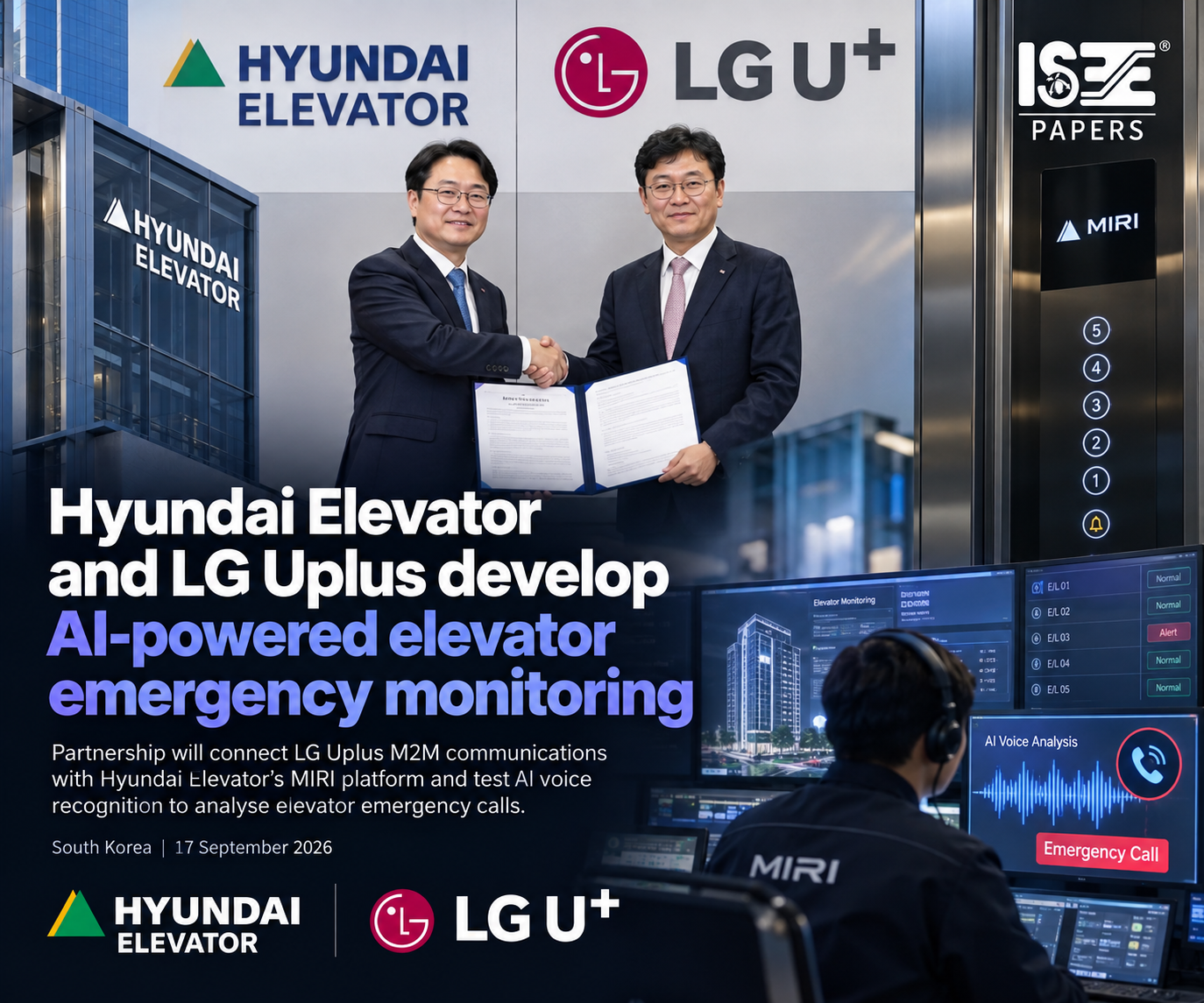

Hyundai Elevator and LG Uplus are strengthening their collaboration to develop a more intelligent elevator remote-monitoring system, combining artificial intelligence, machine-to-machine communications and security technologies to improve emergency response and passenger safety.
The two companies signed a memorandum of understanding on September 15 at the Hyundai Group Building in Jongno, Seoul. The agreement covers cooperation in wireless services, AI and security for smart elevator remote monitoring. The collaboration was announced on September 17.
Connecting MIRI with LG Uplus M2M Technology
A key part of the collaboration will involve integrating LG Uplus’ machine-to-machine (M2M) communication service into the connection between elevators and Hyundai Elevator’s smart remote-monitoring platform, MIRI.
The companies aim to improve the stability and reliability of communications between elevators and the remote-monitoring infrastructure, helping information from connected elevators reach monitoring systems more consistently.
MIRI forms part of Hyundai Elevator’s broader strategy to use connected technologies for elevator monitoring and maintenance.
AI to Analyse Elevator Emergency Calls
One of the most significant elements of the partnership is a planned proof-of-concept for an AI-powered elevator emergency call service.
Emergency communication devices allow passengers to request external assistance when they are trapped inside an elevator or encounter another emergency. However, these systems can also receive accidental activations, simple enquiries and other non-emergency calls.
Hyundai Elevator and LG Uplus plan to apply AI voice-recognition technology so that an AI system can perform an initial analysis of incoming calls. Under the proposed model, AI could respond to simple enquiries or identify apparent malfunctions, while calls classified as emergencies would be directed to dedicated personnel for immediate response.
The approach could help monitoring teams distinguish genuine emergencies from non-critical calls more efficiently, while keeping human personnel involved when urgent intervention is required.
Security Becomes Part of the Connected Elevator Ecosystem
The partnership extends beyond communications and voice recognition.
The companies will also review the potential integration of LG Uplus’ security-monitoring services and U+SASE, its cloud-based network and integrated security platform, with Hyundai Elevator’s MIRI platform.
As elevators become increasingly connected to cloud platforms, monitoring centres and other digital infrastructure, cybersecurity is becoming another consideration alongside mechanical reliability and passenger safety. The planned cooperation reflects this convergence of elevator engineering, telecommunications, AI and digital security.
Partnership Builds on MIRI View
This is not the first collaboration between Hyundai Elevator and LG Uplus in smart elevator safety.
In 2023, the companies jointly developed MIRI View, a service using AI-enabled CCTV inside elevator cabins to identify potentially abnormal situations. The technology can detect events including screams, a person collapsing and unusually prolonged stays inside an elevator, and transmit relevant information to Hyundai Elevator’s customer care centre.
The latest initiative expands that relationship from AI-based video monitoring towards a broader connected ecosystem involving voice recognition, wireless communications, remote monitoring and security.
Moving Towards More Intelligent Elevator Monitoring
The collaboration highlights a wider shift in elevator services from conventional reactive maintenance towards connected, data-driven monitoring.
By combining Hyundai Elevator’s MIRI platform with LG Uplus’ communications, AI and security capabilities, the companies are seeking to improve how elevator systems identify, communicate and respond to potentially critical situations.
LG Uplus said its objective is to combine stable wireless communications with AI and security to advance elevator remote monitoring, while Hyundai Elevator emphasised the importance of faster and more accurate responses to crisis situations.
For the vertical transportation industry, the project is another example of how AI is moving beyond predictive maintenance and traffic optimisation into real-time passenger safety and emergency-response applications.
As connected elevators become more common, technologies capable of interpreting what is happening inside a cabin, rather than simply reporting a technical fault, could become an increasingly important part of next-generation elevator service and monitoring infrastructure.
Source: LG Uplus and DigitalToday, September 2026.