



The new high-rise technology suite combines wireless power and data transfer, AI-enabled controls, ultralight ropes and electromechanical safety systems to tackle the challenges of the next generation of supertall buildings.
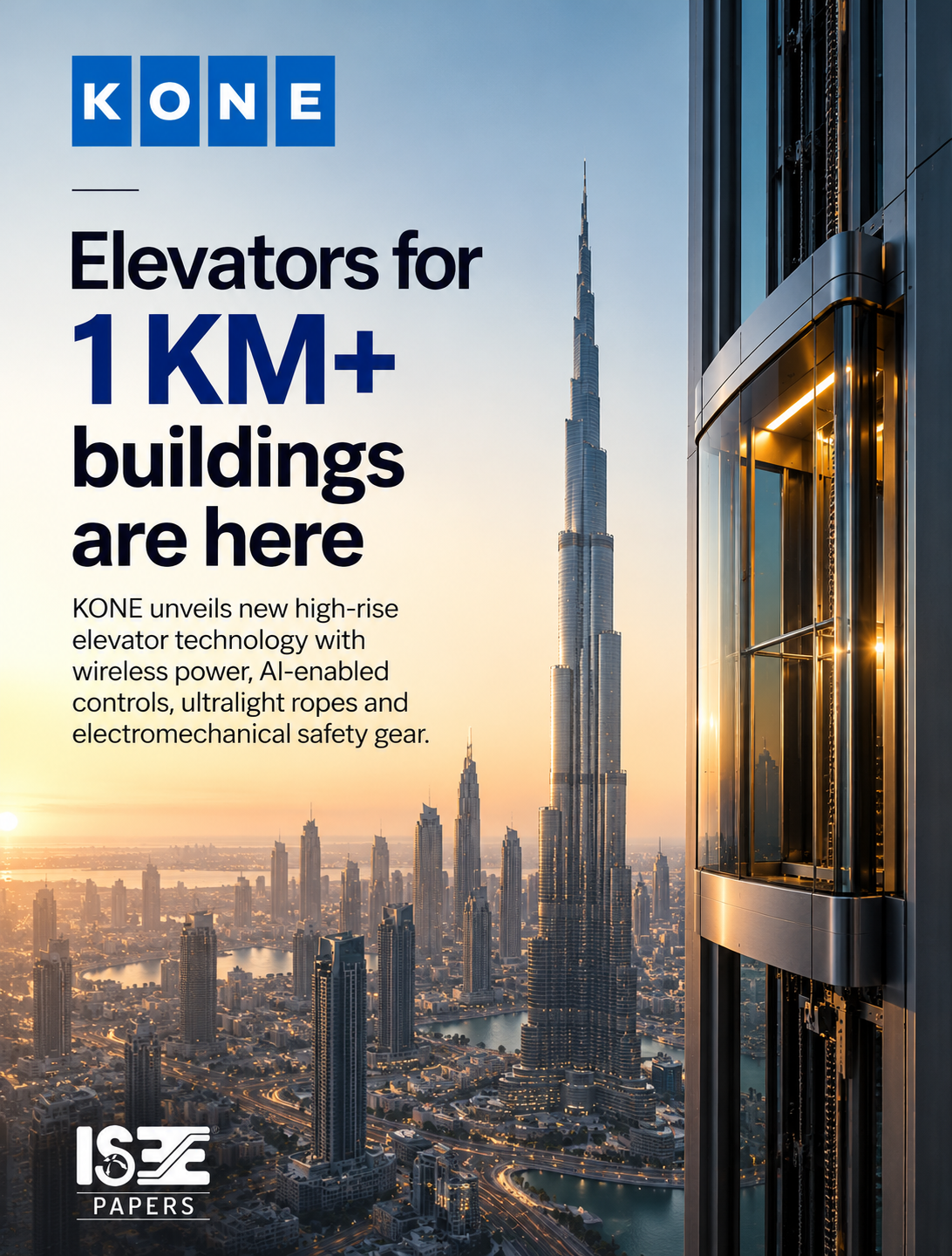
Global elevator and escalator major KONE has unveiled a new suite of high-rise elevator technologies designed to address one of vertical transportation’s biggest engineering challenges: enabling efficient and reliable movement in buildings extending beyond one kilometre in height.
Announced on October 1, 2026, the new high-rise solutions bring together wireless power and data transfer, self-learning AI-enabled control systems, KONE UltraRope® technology, modular hoisting machinery and an electromechanical safety gear system. Together, the technologies are designed to reduce system weight, improve energy and space efficiency, and enable elevators to travel significantly greater distances.
Tackling the limits of conventional elevator systems
As skyscrapers become taller, the weight of elevator components becomes an increasingly significant engineering constraint.
According to KONE, conventional steel-rope elevator systems typically encounter practical travel limitations at around 500 metres. As travel height increases, steel hoisting ropes, travelling cables and other moving components add considerable mass to the system.
KONE’s new solutions aim to reduce this burden by replacing or eliminating several traditionally heavy components.
Its wireless technology, for example, uses wireless data transmission and battery-based energy to eliminate conventional travelling cables and overspeed governor ropes. KONE says this can reduce system mass by approximately 3,000 kg in an elevator travelling 300 metres, while also making operation less susceptible to the effects of building sway.
AI that learns how people move
Artificial intelligence is another major component of the new technology suite.
KONE’s advanced Destination Control System uses self-learning AI to understand traffic patterns within a building and continuously optimise elevator allocation.
By learning how occupants move through a building, the system can position and allocate elevators according to changing demand. KONE says simulations indicate the technology can reduce waiting times by around 60% during peak traffic conditions, while optimised operation can also help reduce unnecessary energy consumption.
For future mixed-use supertall buildings containing residences, offices, hotels, retail and entertainment spaces, managing these complex traffic patterns will become increasingly important.
UltraRope reduces one of the biggest weight challenges
At the centre of KONE’s high-rise strategy is its UltraRope® technology.
First introduced in 2013, UltraRope uses a lightweight carbon-fibre-based construction instead of conventional heavy steel hoisting ropes. KONE says the technology is a fraction of the weight of traditional steel ropes and is more resilient to building sway.
The latest high-rise offering combines UltraRope with KONE’s modular UMX hoisting machines and other technologies to further reduce the amount of material required in ultra-tall elevator installations.
According to KONE, UMX hoisting machines alone can eliminate as much as seven to eight tonnes of material from an ultra-tall building. The company also estimates that UltraRope can help avoid up to 112 tonnes of CO₂ equivalent over a typical 25-year lifecycle through reduced maintenance and rope replacement requirements.
Replacing traditional safety components
KONE has also introduced an electromechanical safety gear system as part of the new high-rise portfolio.
The system replaces a traditional rope-based safety device with a digital alternative, removing the need for a conventional governor rope.
Combined with wireless power and data transfer and battery technologies, this approach reduces the amount of equipment that needs to travel with the elevator car, an increasingly important consideration as elevator journeys become longer.
Burj Azizi to put the technology into action
The announcement comes alongside confirmation that technologies from KONE’s new high-rise portfolio will be deployed at Burj Azizi in Dubai.
The mixed-use tower is planned to reach 725 metres and will feature 59 elevators and 15 escalators supplied by KONE, with elevator speeds reaching up to 10 metres per second.
One KONE MiniSpace™ elevator at the development is planned to travel 631.5 metres in a single journey, which KONE says will make it one of the world’s longest single elevator journeys.
The project provides a real-world application of technologies that KONE believes can eventually support buildings extending beyond the one-kilometre threshold.
More space for architects and developers
The technology suite is also designed to address another major challenge in high-rise development: space.
KONE’s MiniSpace™ solutions are intended to reduce the amount of space required for elevator infrastructure. The company says the configuration can potentially create room for an additional floor while eliminating the requirement for a dedicated basement level in certain applications.
Its MiniSpace™ DX Double Deck system can further increase passenger capacity by transporting more people while requiring fewer elevator shafts.
For developers of supertall buildings, where every square metre of usable floor area can carry substantial commercial value, reducing the space occupied by vertical transportation infrastructure could become increasingly significant.
Elevator engineering for the kilometre-high city
The launch reflects how elevator technology is evolving alongside increasingly ambitious high-rise architecture.
Future kilometre-plus buildings create challenges extending beyond simply increasing elevator speed. Engineers must manage the weight of ropes and cables, building sway, energy consumption, passenger traffic, shaft utilisation, safety and long-term maintenance across unprecedented vertical distances.
KONE’s latest portfolio attempts to address several of these constraints as an integrated system rather than through a single technology.
The company also says some of the innovations developed for supertall buildings can be applied to existing and medium-rise properties, including technologies aimed at improving people flow, increasing energy efficiency and enabling higher-speed elevators within existing shafts.
As developers and architects continue exploring buildings beyond the kilometre mark, advances in vertical mobility will be central to determining how practical those structures ultimately become.
For the elevator industry, KONE’s latest launch signals that the engineering race is no longer focused only on today’s tallest towers. It is increasingly about developing the technologies required for the next generation of vertical cities.