




Finland | Technology | Artificial Intelligence | Elevators & Escalators
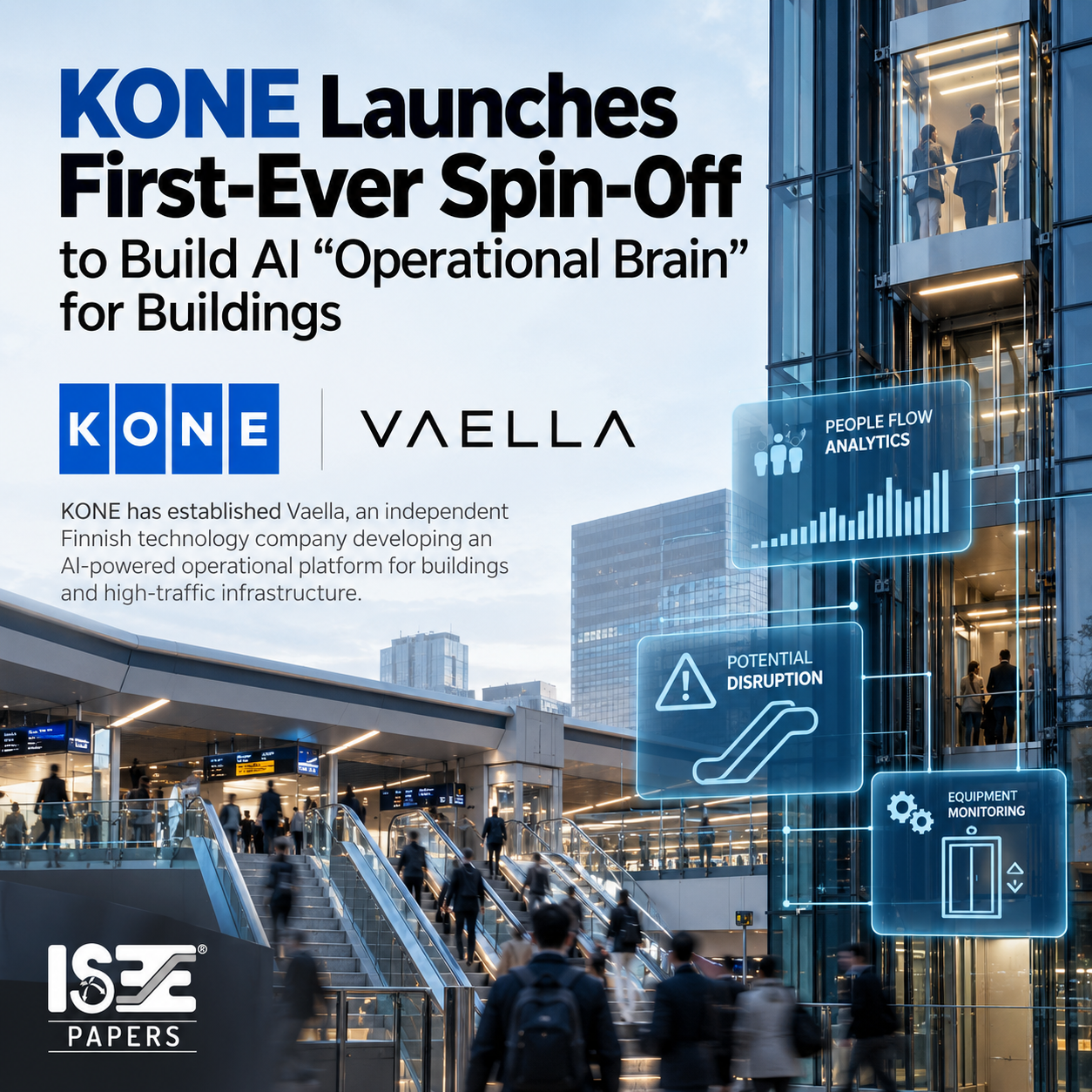
KONE has launched its first-ever spin-off company, VAELLA, marking a significant expansion of the elevator and escalator major’s innovation efforts beyond conventional vertical mobility.
The independent Finnish technology company is developing an AI-powered operational platform for buildings and high-traffic public infrastructure, using technology that originated from KONE’s Station Twin innovation.
VAELLA is designed to bring together information that is typically spread across multiple building systems and turn it into a unified, real-time operational view. Its technology combines sensor information, building and equipment data, digital twins and artificial intelligence to help operators identify potential disruptions before they escalate.
From Station Twin to an Independent Technology Company
VAELLA emerged from KONE’s Station Twin work, which created digital 3D representations of locations such as metro stations and combined them with real-time sensor data on how people move through those environments.
KONE has now spun the technology out into an independent company, allowing VAELLA to develop and commercialise the platform beyond KONE’s traditional elevator and escalator business.
According to KONE, the move is also an experiment in finding new ways to scale innovations beyond its core operations through external partnerships and funding. KONE described VAELLA as its first exploration of this type of innovation model.
An AI “Operational Brain” for Buildings
At the centre of VAELLA’s proposition is what the company describes as a Building AI Operator.
Instead of functioning simply as another building-management dashboard, the platform is intended to work alongside facility and operations teams. It can analyse information from sensors and operational systems, maintain a digital history of the building, identify unusual conditions and recommend actions.
For elevator and escalator operations, this could be particularly significant.
The system can monitor people flow alongside equipment information, helping identify situations such as overcrowding, unusual lobby queues and potential elevator or escalator disruptions. VAELLA says its AI Operator can also support actions such as rerouting vertical transportation, alerting relevant personnel and providing operational context during disruptions.
Why Real-Time Data Matters
Modern buildings and transport infrastructure already generate enormous amounts of information.
Elevators generate operational and dispatch data. Building management systems monitor equipment. Access-control systems track movement through entrances. Maintenance systems record faults and service activity. Sensors can monitor occupancy and passenger flows.
The problem is that these systems often operate separately.
VAELLA is designed to connect these fragmented sources into a common operational picture, allowing AI to understand not only what individual equipment is doing, but also what is happening around it.
For example, an escalator fault at a busy metro station is more than an equipment issue. It can change passenger movement, increase congestion elsewhere and potentially create accessibility or safety problems.
Combining equipment status with real-time people-flow information could therefore enable operators to understand the wider impact of a disruption and respond accordingly.
Privacy-First Approach to Monitoring
Another notable element of the technology is its approach to sensing.
Rather than depending exclusively on conventional camera-based surveillance, VAELLA says its Vision Sensors can detect occupancy, density and movement without capturing images that identify individuals.
The company positions itself as a European vision-AI technology operation designed with GDPR and EU AI Act considerations in mind. It also says customer information can remain within Europe, or even within individual buildings depending on deployment.
Tested in Helsinki and Brussels
The technology has already moved beyond the conceptual stage.
Initial pilot and validation work has taken place in real operational environments in Helsinki and Brussels, including public transport settings.
Tests have explored applications including detecting crowd build-up, responding to passenger incidents, managing accessibility disruptions and optimising energy use.
Potential applications extend well beyond metro stations.
VAELLA is targeting environments including airports, railway and transport hubs, stadiums, ferry terminals, offices, retail environments and large commercial buildings, where managing large numbers of people alongside elevators, escalators and other infrastructure can become operationally complex.
KONE Looks Beyond the Elevator
For KONE, VAELLA represents an interesting strategic development.
The company has traditionally focused on moving people vertically through buildings and urban infrastructure. With technologies such as Station Twin and now VAELLA, that expertise is increasingly extending toward understanding and managing the entire movement of people through physical environments.
KONE Chief Innovation Officer Amy Chen said the spin-off structure is intended to give the innovation greater freedom to address customer challenges while helping promising technologies scale through new models.
VAELLA is led by co-founder and CEO Fabien Fédy, alongside a team with experience developing digital products and people-flow technologies at KONE.
What This Could Mean for the Elevator Industry
VAELLA points toward a broader shift taking place across the vertical transportation sector.
Connected elevators and escalators have already made remote monitoring, predictive maintenance and equipment-level analytics increasingly common. The next stage could involve connecting that intelligence with information about how entire buildings are actually being used.
Instead of asking only whether an elevator is operating correctly, an intelligent building platform could also understand:
- How many people are waiting for it
- Whether congestion is developing elsewhere
- How an equipment failure will affect passenger movement
- Whether vertical transportation should be dynamically rerouted
- Which operational teams need to respond
- How similar incidents were handled previously
That changes the role of elevator data from equipment monitoring to a component of wider building intelligence.
For airports, metro systems, stadiums, commercial towers and other high-footfall developments, the combination of AI, digital twins, real-time people-flow sensing and connected vertical transportation could become an increasingly important layer of building operations.
With VAELLA, KONE is effectively taking technology developed around people flow and giving it a company of its own.
And that could be the more significant story: the future of elevators and escalators may not only be about smarter machines, but about buildings that understand how people move through them and can respond in real time.
Source: KONE, VAELLA, LIFTjournal and Elevator World
Original VAELLA launch: 10 June 2026