








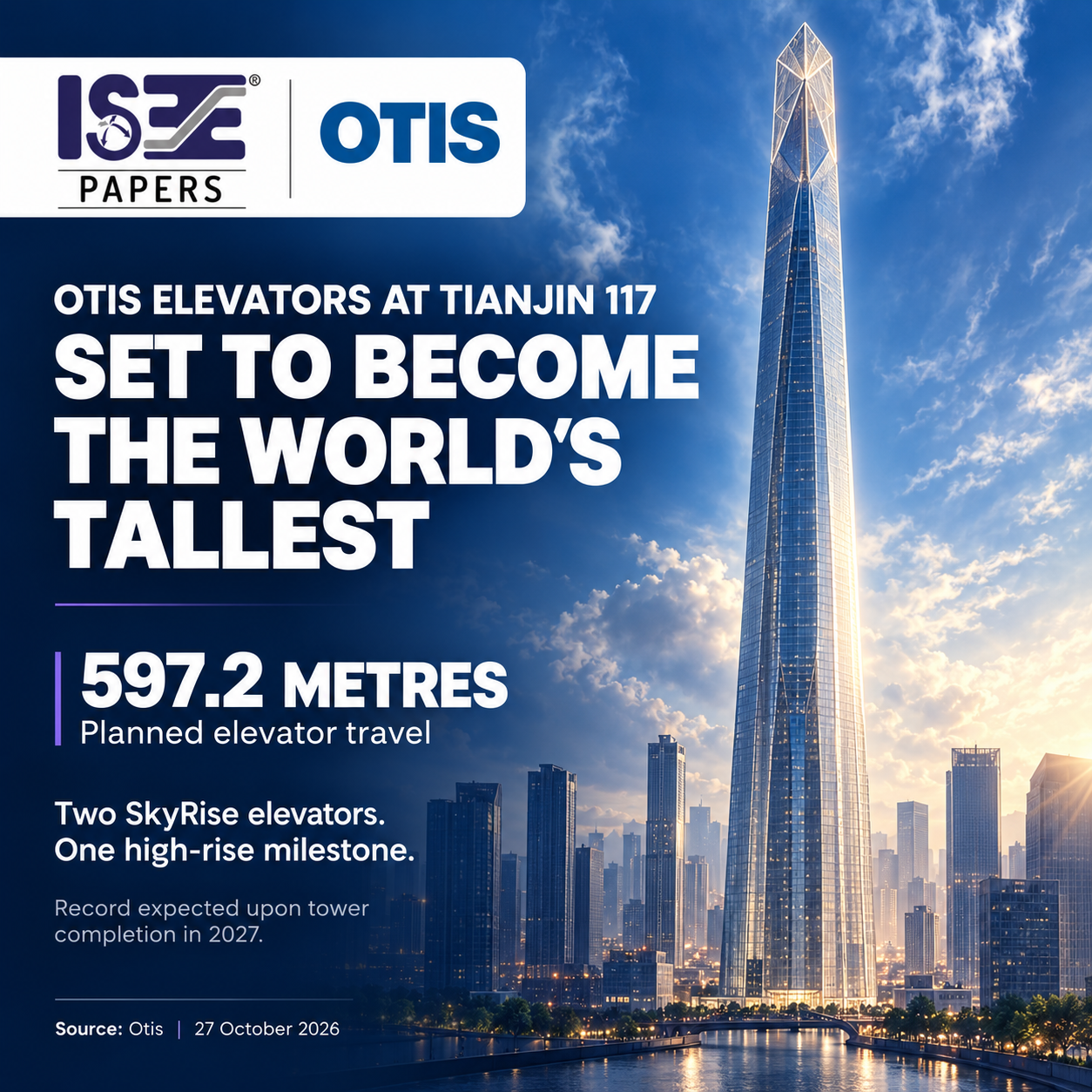
Two SkyRise elevators with a planned travel distance of 597.2 metres mark a significant development in supertall building mobility.
28 October 2026: Otis has announced a milestone for the Tianjin 117 tower in China, where two of its SkyRise elevators are set to become the world’s tallest elevators in a building. The company published the announcement in its newsroom on 27 October 2026.
According to Otis, each elevator will travel 597.2 metres between the building’s lower levels and its observation deck. The company said the Council on Vertical Urbanism has recognised both installations under the designation “World’s Tallest Lift (Elevator) in a Building.” The council also lists Tianjin 117 among its Buildings of Distinction, with recognition dated October 2026.
The record remains subject to the tower’s completion. Reporting on the announcement states that formal recognition is expected when construction finishes in 2027. The milestone therefore concerns the planned installation and its exceptional vertical reach, rather than confirmation that the elevators have entered passenger service.
The announcement builds on Otis’s wider involvement in the nearly 600-metre tower. In August 2026, the company confirmed that its scope covers 251 elevators and escalators, including new installations, refurbishment and modernisation of existing equipment, and ongoing service. Otis was first selected for the project’s initial construction phase in 2013.
Beyond the two record-setting elevators, the planned installation includes 53 SkyRise double-deck and super double-deck elevators. Three super double-deck units are designed to travel up to 463 metres at speeds of up to 10 metres per second. Two double-deck elevators are specified for speeds of up to 12 metres per second, the fastest in Otis’s portfolio.
Double-deck elevators use two vertically stacked cabins to serve adjacent floors through a single shaft. Super double-deck systems can adjust the spacing between the cabins to accommodate different floor heights. These configurations help address the space and passenger-handling demands of tall buildings.
Otis’s engineering package also addresses ride comfort, energy recovery and operational monitoring. The company says its SkyRise systems use aerodynamic cabin design supported by airflow simulation and wind-tunnel testing. ReGen drives return energy to the building’s electrical network during braking, while Panorama 3 elevator management and Otis ONE connected service technology support monitoring, dispatching and predictive maintenance.
For the vertical transportation industry, Tianjin 117 presents a project to watch as installation and completion progress. Its combination of long elevator travel, double-deck systems and connected maintenance illustrates the range of engineering requirements involved in moving people through a supertall building.
–
Get your story in front of the right industry audience with ISEE Papers, generating 2 lakh+ impressions every month across the elevator, escalator, real estate and construction industries.
📩 thomas@iseepapers.com
📞 +91 99879 88332
Disclaimer: This post is based on publicly available news and company information. Logos and trademarks belong to their respective owners. Images are for editorial and representational purposes and may include AI-generated or AI-enhanced elements.