Beyond Touchless: The Era of Proximity-Based Mobility
TOKYO, JAPAN — As we move through the first quarter of 2026, the vertical transportation industry is witnessing the transition from “Touchless” to “Intuitive” mobility. Leading Japanese innovators Hitachi and Mitsubishi Electric have unveiled a new generation of elevator systems that effectively “predict” a passenger’s journey before they even reach the elevator bank.
The News: From Buttons to Presence
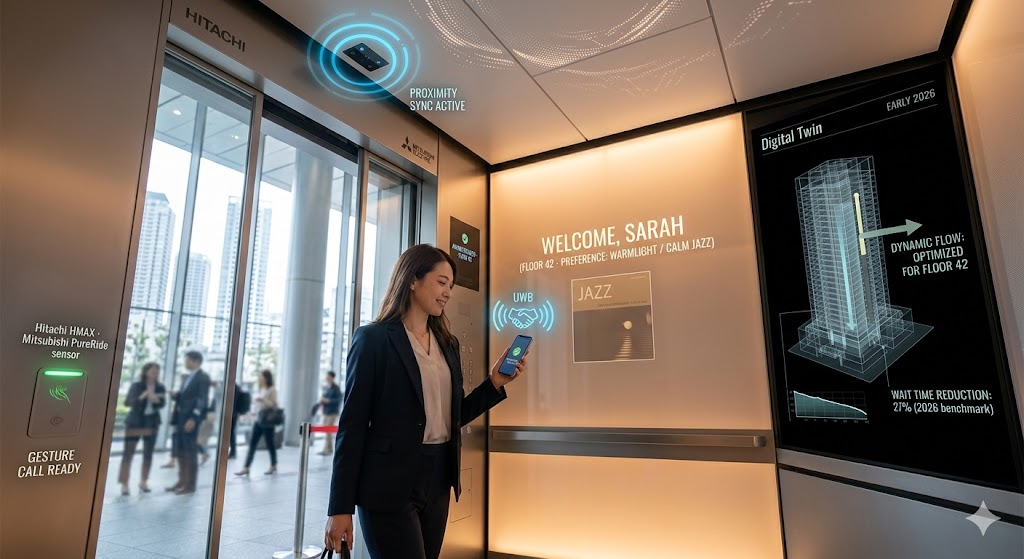
While the touchless wave of 2024 focused on IR-sensors and voice, the 2026 standard is built on Proximity-Based Mobility. Using Bluetooth Low Energy (BLE) and Ultra-Wideband (UWB) technology, elevators now communicate directly with a passenger’s smartphone or wearable device.
Non-Inductive Calling: As a passenger walks toward the lobby, the building’s security system authenticates their credentials and automatically “calls” the most efficient car for their destination floor.
Gesture-Based Refinement: For visitors or those without pre-synced devices, Mitsubishi’s PureRide™ and Hitachi’s latest HMAX suites utilize high-fidelity gesture recognition. A simple upward swipe in the air 10 cm from the sensor registers a call—eliminating the need for any physical contact in high-traffic, noisy lobbies where voice commands often fail.
Innovation: The Passenger Experience (PX) Digital Twin
The most significant breakthrough in 2026 is the synchronization of these systems with a building’s Digital Twin. By linking vertical movement to the building’s “digital heart,” the elevator experience has become hyper-personalized.
Environmental Personalization: When a passenger is identified, the elevator interior—including lighting temperature, digital wall displays, and even background audio—automatically adjusts to their saved preferences.
Dynamic Flow Optimization: The Digital Twin analyzes real-time occupancy data. If the system “sees” a large group entering the lobby via security cameras, it preemptively stages multiple cars to handle the surge, reducing wait times by an average of 25% compared to 2024 benchmarks.
Impact: Hygiene and Efficiency as One
This evolution addresses the two biggest demands of modern urban living: Hygiene and Time. By removing physical touchpoints, buildings are inherently safer from surface-level transmissions. Simultaneously, by making the “call” process invisible and automatic, the industry is moving closer to a “frictionless” office environment where the elevator is no longer a bottleneck, but a seamless extension of the lobby.