
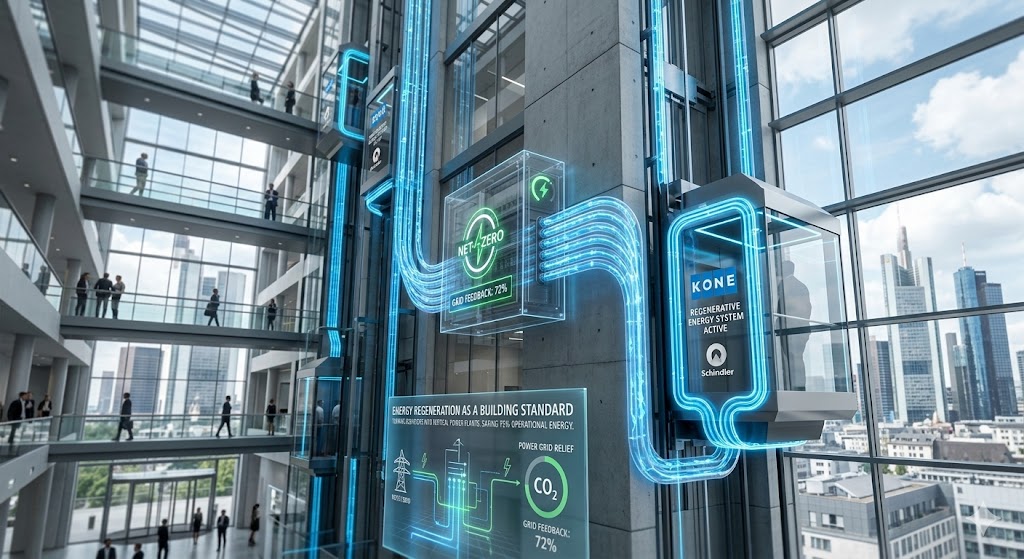
The New Standard: Elevators as Power Plants
The New Standard: Elevators as Power Plants FRANKFURT, GERMANY — In a landmark shift for urban architecture, Energy Regeneration has officially moved from a “green luxury” to a mandatory engineering standard for high-rise developments in 2026. Global leaders like Schindler and KONE have integrated regenerative drive technology into 100% of their new high-speed product lines, effectively turning every elevator shaft into a vertical power plant. The Engineering: Capturing “Wasted” Motion At the heart of this Sustainability breakthrough is the Regenerative Drive. Traditional elevators dissipate energy as heat through resistors during two specific phases: when a heavily loaded car travels down, or when an empty car travels up. By 2026, engineering advancements have perfected the ability to capture this kinetic energy and convert it back into clean electricity. “We are no longer just looking for efficiency; we are looking for net-positive contributions,” says a Lead Engineer at KONE. “Our latest systems return up to 75% of the energy used during a cycle directly back into the building’s internal microgrid.” Sustainability: The Path to Net-Zero With urban centers aiming for aggressive carbon neutrality targets, the VT industry’s shift to energy regeneration is a critical piece of the puzzle. This technology is now a primary requirement for achieving LEED Platinum and BREEAM Outstanding ratings. Grid Relief: By feeding power back into the building, elevators reduce the peak load on city electrical grids. Heat Reduction: Because these systems don’t “burn off” energy as heat, the demand on building cooling systems (HVAC) is reduced by an average of 15% in the elevator machine area. Operational Savings: For a 50-story commercial tower, these engineering gains translate to thousands of dollars in annual utility savings. The Impact: A Decarbonized Sky The standardizing of these drives marks a pivotal moment in Engineering. By treating the elevator as a dynamic part of the building’s energy ecosystem rather than a drain, the industry is proving that vertical density can coexist with environmental stewardship. As we move further into 2026, the question is no longer if a building will regenerate its energy, but how much power it will contribute back to the city.