










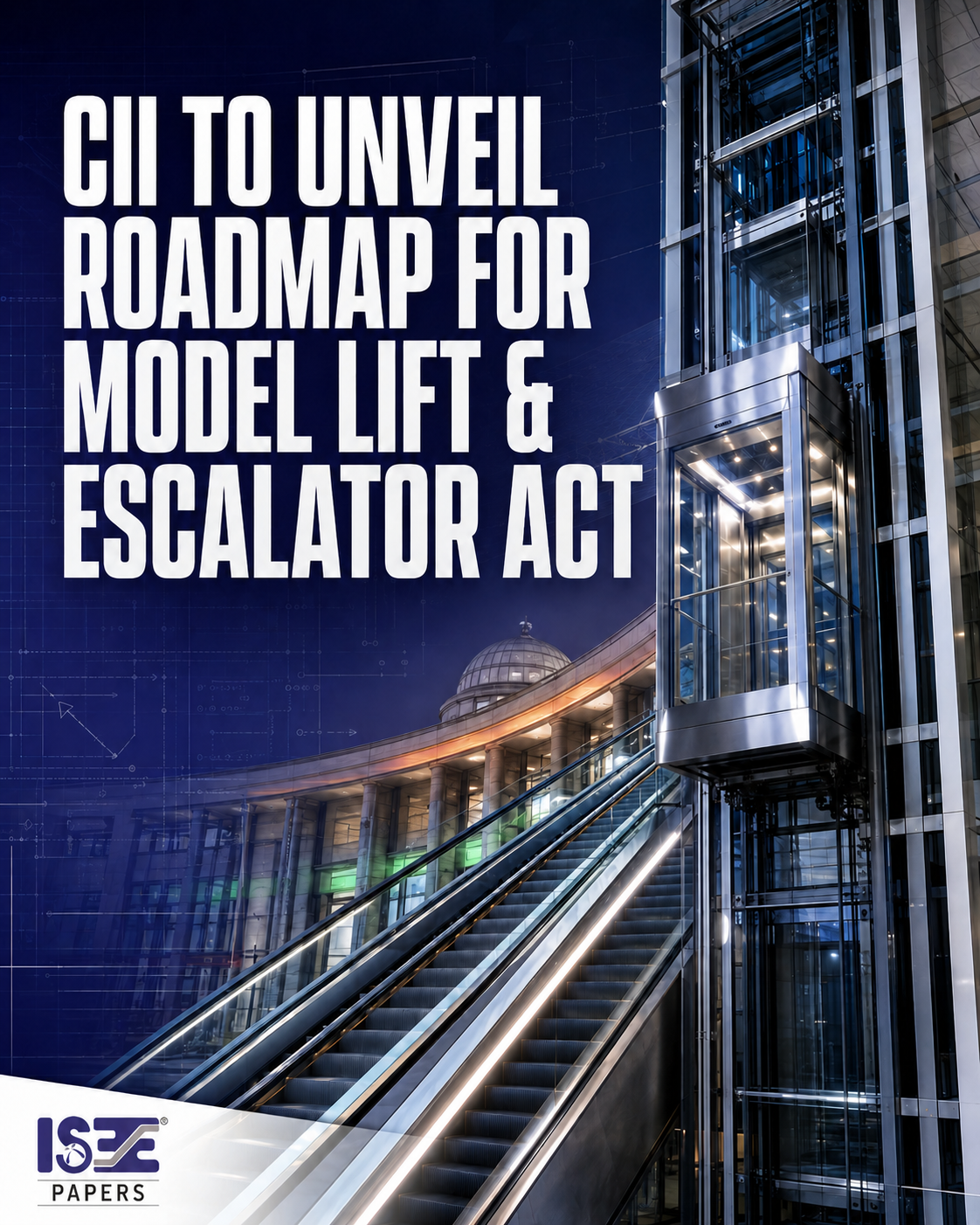
The policy roundtable in New Delhi will focus on regulatory harmonisation, digital governance, simpler compliance and stronger safety standards across India’s vertical mobility sector.
The Confederation of Indian Industry (CII) is set to present a roadmap for a proposed Model Lift and Escalator Act at a policy roundtable in New Delhi today, marking a significant step towards a more consistent regulatory framework for India’s vertical mobility sector.
The roundtable, titled Policy Roundtable on Regulatory Harmonisation for the Lifts, Escalators & Building Technologies Sector, will be held at the India Habitat Centre from 2:00 pm to 4:00 pm. The event is also listed on CII’s official calendar for 14 August 2026.
As part of the programme, CII will launch its report, Enabling Ease of Doing Business in the Lifts, Escalators & Building Technologies Sector. The report will be presented alongside the proposed Model Lift and Escalator Act, which is expected to offer a policy framework for improving regulatory coordination, digitising administrative processes, simplifying compliance and strengthening safety.
Addressing India’s fragmented regulatory environment
The initiative seeks to address one of the long-standing challenges faced by the elevator and escalator industry in India: variations in rules, approvals and compliance requirements across states.
Manufacturers, installation companies, maintenance providers, developers and building owners often need to work with different procedures and regulatory expectations depending on the location of a project. These differences can add complexity to approvals, inspections, licensing and ongoing compliance.
A model framework could provide states and regulatory authorities with a common reference point while allowing them to adapt provisions to their respective requirements. Greater alignment could also make it easier for companies operating across multiple states to follow consistent procedures and safety practices.
Digital governance to form a key part of the discussion
Digital governance is expected to be a major focus of the proposed roadmap. Wider use of online systems could help streamline applications, registrations, inspection records, licence renewals and compliance documentation.
Digitised processes could also improve transparency by making it easier for authorities and building owners to access equipment records and track regulatory obligations. For the industry, a more predictable approval system could reduce administrative delays and make compliance easier to manage.
However, the roundtable is expected to consider ease of doing business alongside public safety. Lifts and escalators are essential building systems used daily across residential developments, commercial complexes, hospitals, airports, railway and metro stations, shopping centres and other public infrastructure.
Any regulatory reform will therefore need to maintain strong requirements covering installation, inspection, operation and maintenance.
Policymakers and industry leaders to participate
CII has indicated that the roundtable will bring together policymakers, regulators, development authorities, real estate developers, industry representatives, academics and technical specialists.
The mix of participants is expected to support a broader discussion on how regulations can keep pace with India’s rapidly expanding built environment. It may also help identify areas where cooperation between government bodies and industry stakeholders can improve both compliance and safety outcomes.
According to CII Infrastructure’s announcement, the proposed framework is intended to contribute to a more harmonised, digitally enabled and competitive operating environment for the sector.
A potentially important policy milestone
The launch comes at a time when vertical mobility systems are becoming increasingly important to the functioning of Indian cities. Growing urban density, taller buildings and the expansion of public infrastructure are increasing demand for safe, reliable and efficiently regulated lifts and escalators.
The proposed Model Lift and Escalator Act could become an important reference for future reforms, particularly if its recommendations help reduce procedural differences while establishing clearer safety and compliance expectations.
Attention will now turn to the provisions contained in the report, the recommendations emerging from the roundtable and how the proposed framework is received by state governments, regulatory authorities and industry stakeholders.
The release of the CII report today is expected to begin a wider policy conversation on creating a regulatory system that supports industry growth without compromising passenger safety.