
The Digital Lift: Virtual Maintenance Redefining the Service Grid
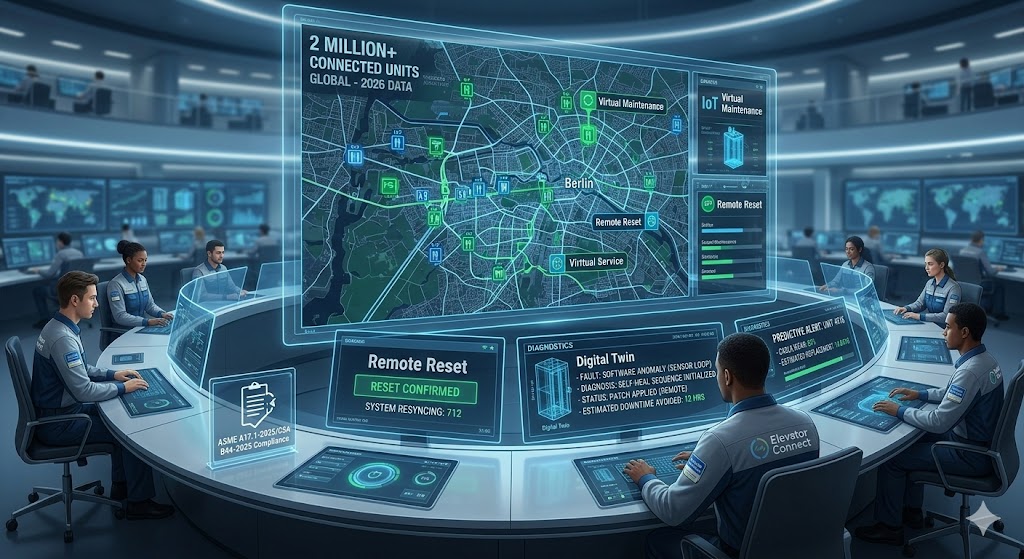
BERLIN, GERMANY — In the first half of 2026, the vertical transportation (VT) industry has officially crossed a digital rubicon. The “technician in the shaft” model—a century-long staple of urban maintenance—is being rapidly supplemented by Cloud-Based Remote Operations. According to recent industry data, over 2 million elevator and escalator units globally are now permanently tethered to IoT ecosystems like Otis MAX and Schindler Ahead.
The News: A Global Network of Connected Shaffts
The scale of the “Connectivity” shift is staggering. Otis, which currently holds nearly 32% of the remote monitoring market share, has successfully integrated AI-driven diagnostics into its global service portfolio. By 2026, these cloud platforms are no longer just sending “broken” alerts; they are managing the heartbeat of entire city districts.
Market Growth: The elevator remote monitoring market has surged, driven by a 2026 push for “Smart City” infrastructure.
Global Leaders: Alongside Otis and Schindler, Asian giants like Hitachi and Hyundai Elevator (the latter serving 85% of South Korean installations) have turned elevators into data-generating assets that communicate with building management systems in real-time.
Innovation: The Rise of the “Remote Reset”
The most transformative “Intelligence” feature of 2026 is the Remote Interaction Operation. Previously, any minor sensor glitch—such as a door obstruction or a brief power surge—required a physical visit from a technician. Now, under the updated ASME A17.1-2025/CSA B44-2025 safety codes, qualified service teams can perform “Remote Resets” and software patches from centralized operations centers.
Self-Correction: If an elevator identifies a minor non-safety-critical software loop, it can often initiate a “self-heal” sequence.
Downtime Reduction: These virtual interventions have reduced physical call-outs by up to 20%, and in some high-density commercial zones, unscheduled downtime has plummeted by 50%.
Software Patches: Just like a smartphone, elevators in 2026 receive over-the-air (OTA) updates to optimize speed profiles and energy usage without a single minute of “out of service” time.
The Impact: From Reactive to Predictive
The “Modernization” of maintenance is fundamentally changing the economics of building ownership. By shifting from Time-Based Maintenance (checking things because the calendar says so) to Condition-Based Maintenance (checking things because the data shows wear), the industry is extending component lifespans by an estimated 30%.
As we move deeper into 2026, the goal is clear: a “Zero-Failure” future. For the millions of daily passengers, this means the most reliable elevator is the one they never have to think about—because the “technician” fixed it from a cloud server three hours before a human ever noticed a problem.