



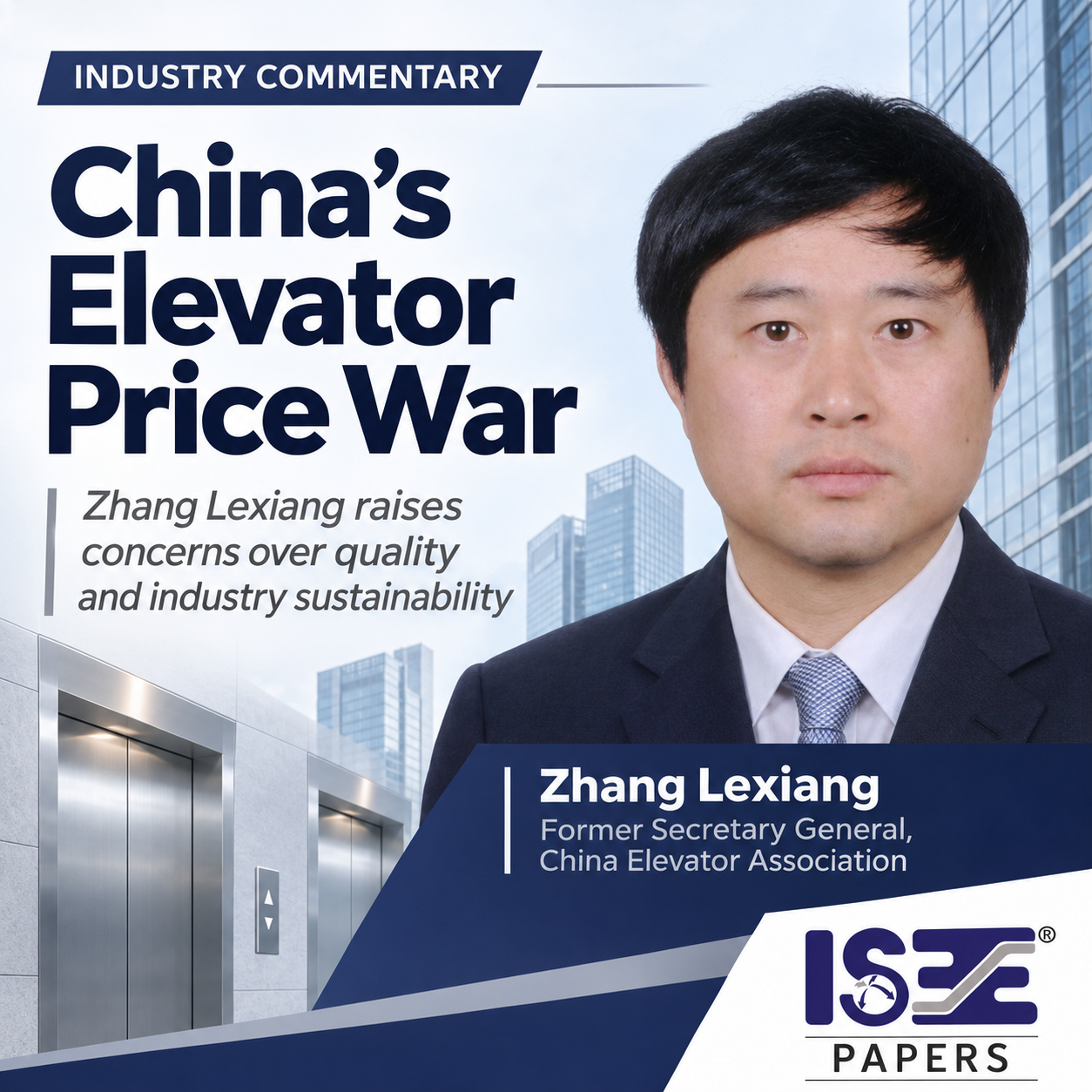
Former China Elevator Association Secretary General questions whether the industry’s focus on sales volume is undermining product quality, supplier stability and long-term customer value.
China’s elevator industry faces mounting pressure to move beyond volume-driven competition as weaker demand for new installations and falling prices reshape the market, according to industry veteran Zhang Lexiang.
In commentary shared on LinkedIn, Zhang, a former Secretary General of the China Elevator Association, argued that aggressive pricing and persistent cost reductions risk weakening the foundations of the industry. His assessment addresses market demand, supplier relationships, component durability and the transparency of reported business figures.
From Rapid Expansion to a Changing Market
According to Zhang, China’s elevator market expanded rapidly from around 2000, with annual new installations eventually reaching approximately 1.2 million units. He estimates that the installed base grew to around 15 million units.
These figures are estimates cited in his commentary and have not been independently verified for this article.
During the expansion, manufacturers invested in factories and branch networks, building businesses around expectations of continued growth. Zhang argues that this approach has become increasingly difficult to sustain as the property downturn has reduced demand for new elevators.
He estimates that annual new installations are now approximately 20% below their peak. Modernisation, elevators for single-family and rural homes, and exports have become alternative sources of demand.
However, his central concern is that maintaining unit volumes does not necessarily protect revenue or profitability when selling prices continue to fall.
Pricing Examples Highlight Commercial Pressure
To illustrate the intensity of competition, Zhang cited a standard elevator serving 10 stops, with a capacity of 1,000 kg and a speed of 1.75 metres per second.
According to his account, such a unit can be priced at approximately RMB 50,000 ex-works or RMB 75,000 installed. He also cited a quotation of RMB 120,000 for a turnkey project involving a 30-stop elevator with a capacity of 1,000 kg and a speed of 2.5 metres per second.
The examples were presented without supporting quotation documents in the material available for this article. They should therefore be understood as figures reported by Zhang, rather than independently established market benchmarks.
His broader argument is that competition centred on the initial purchase price can leave insufficient room for durable components, installation quality and long-term service obligations.
Supplier Relationships Under Strain
Zhang also raised concerns about the pressure placed on component suppliers through recurring price reductions and longer payment periods.
He described payment terms extending from 60 to 90 days and argued that sustained commercial pressure can encourage reductions in material specifications and manufacturing processes.
His commentary linked such practices to potential quality and safety problems. However, the supplied material did not include incident reports or investigation findings establishing those connections.
The concern he raises is whether procurement practices support consistent quality throughout the supply chain, particularly when manufacturers and suppliers face shrinking margins.
Questions Over Component Life and Accountability
Another focus of Zhang’s commentary was the durability of coated steel belts and wire ropes used in elevator suspension systems.
He questioned whether service-life expectations, replacement costs and warranty commitments are adequately aligned with operating conditions. He also raised allegations concerning premature belt failures and maintenance practices.
These claims were not accompanied by independently verifiable technical records in the supplied text. His references to regulatory requirements would also require examination of the applicable official documents before being reported as confirmed obligations.
The broader issue highlighted in his commentary is the need for clear responsibility across component selection, installation, inspection, maintenance and replacement throughout an elevator’s operating life.
Concerns About Market Reporting
Zhang further questioned the reliability of some market-size estimates and reported orders, alleging that certain booking practices could distort perceptions of market share.
The supplied commentary did not identify specific companies or provide supporting financial records. These statements remain unverified allegations and do not establish misconduct by any manufacturer, distributor or auditor.
A Call to Reconsider Industry Priorities
Zhang’s overall assessment calls for a stronger focus on quality, innovation, safety and customer value as China’s elevator market adjusts to slower new-installation demand.
He argues that continued price reductions can create a damaging cycle if they weaken product durability, service quality and customer confidence.
His commentary places a central question before the industry: whether its commercial practices can support reliable elevator performance and sustainable service commitments over the full life of the equipment.
For the author’s full commentary and accompanying document, read Zhang Lexiang’s original LinkedIn post.
Source: LinkedIn commentary by Zhang Lexiang, identified in the supplied material as former Secretary General of the China Elevator Association.
Editorial disclaimer: This article reports Zhang’s views and claims based on the text supplied to ISEE Papers. The referenced attachment was not available for review, and the linked post could not be independently accessed. Market estimates, pricing examples, technical claims, regulatory references and allegations have not been independently verified.