


Schindler’s Wushan Escalator System Turns a Mountain City Into a Vertical Mobility Landmark
Disclaimer: This video is sourced from Schindler’s official LinkedIn page . All rights and ownership of the original content belong to Schindler Group. This video is used strictly for informational and editorial purposes.
In Wushan, China, the daily challenge of moving through steep urban terrain has been answered with one of the most striking vertical transportation projects in the world.
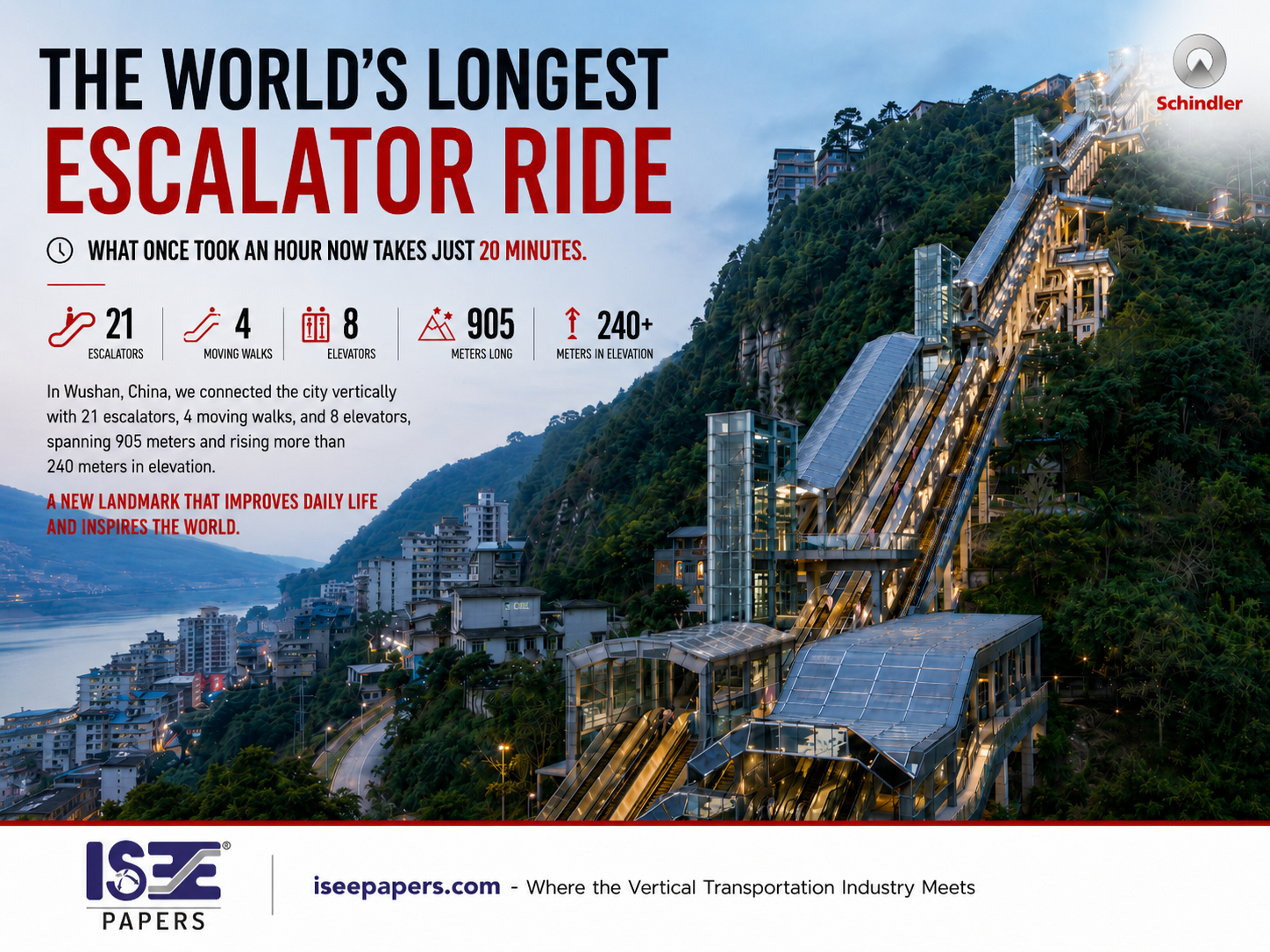
The newly opened Wushan escalator system has been described as the world’s longest escalator ride. Stretching approximately 905 metres and rising more than 240 metres in elevation, the project has transformed a journey that once took close to an hour into a ride of around 20 minutes.
The system is not a single continuous escalator. It is an integrated urban mobility route made up of 21 escalators, 4 moving walks, and 8 elevators. Together, these elements create a continuous vertical connection across the mountainous landscape of Wushan.
For a city shaped by height and difficult terrain, the project is more than a record-breaking installation. It is a piece of civic infrastructure. By reducing travel time and improving accessibility between lower and higher parts of the city, the system shows how elevators, escalators, and moving walks can serve as part of a city’s larger movement network, not just as equipment inside buildings.
The Wushan project shows how vertical transportation can become public infrastructure, connecting people, improving access, and creating a landmark at the same time.
A Mobility Route With Civic and Tourism Value
The impact of the project is both practical and economic. The Wushan escalator system improves daily connectivity for residents while also becoming a new attraction for visitors. Its scale, location, and engineering presence have helped turn it into a destination in its own right.
This combination of public utility and tourism value is significant. Infrastructure is often judged only by efficiency, but projects like this demonstrate how mobility systems can also shape the identity of a city. In Wushan, the escalator route does not simply move people from one level to another. It changes how the city is experienced.
Vertical Transportation Beyond Buildings
Schindler’s role in the project highlights the expanding contribution of vertical transportation companies to urban infrastructure. In mountainous and high-density cities, vertical movement is not secondary to transport planning. It is central to how people access homes, workplaces, public spaces, transport corridors, and tourist destinations.
The Wushan project also offers a larger lesson for the elevator and escalator industry. As cities continue to grow in complex geographies, vertical transportation will increasingly move beyond malls, stations, airports, and towers. It will become part of the public realm, solving access challenges at civic scale.
In Wushan, the result is a landmark that does more than move people upward. It connects the city, shortens daily journeys, and shows how infrastructure can improve everyday life while creating a destination in its own right.
Disclaimer: This article is published for informational and editorial purposes only. Views expressed may not reflect those of ISEE Papers. We do not guarantee accuracy or completeness. For full details, please read our complete disclaimer here: ISEE Papers Website Disclaimer