










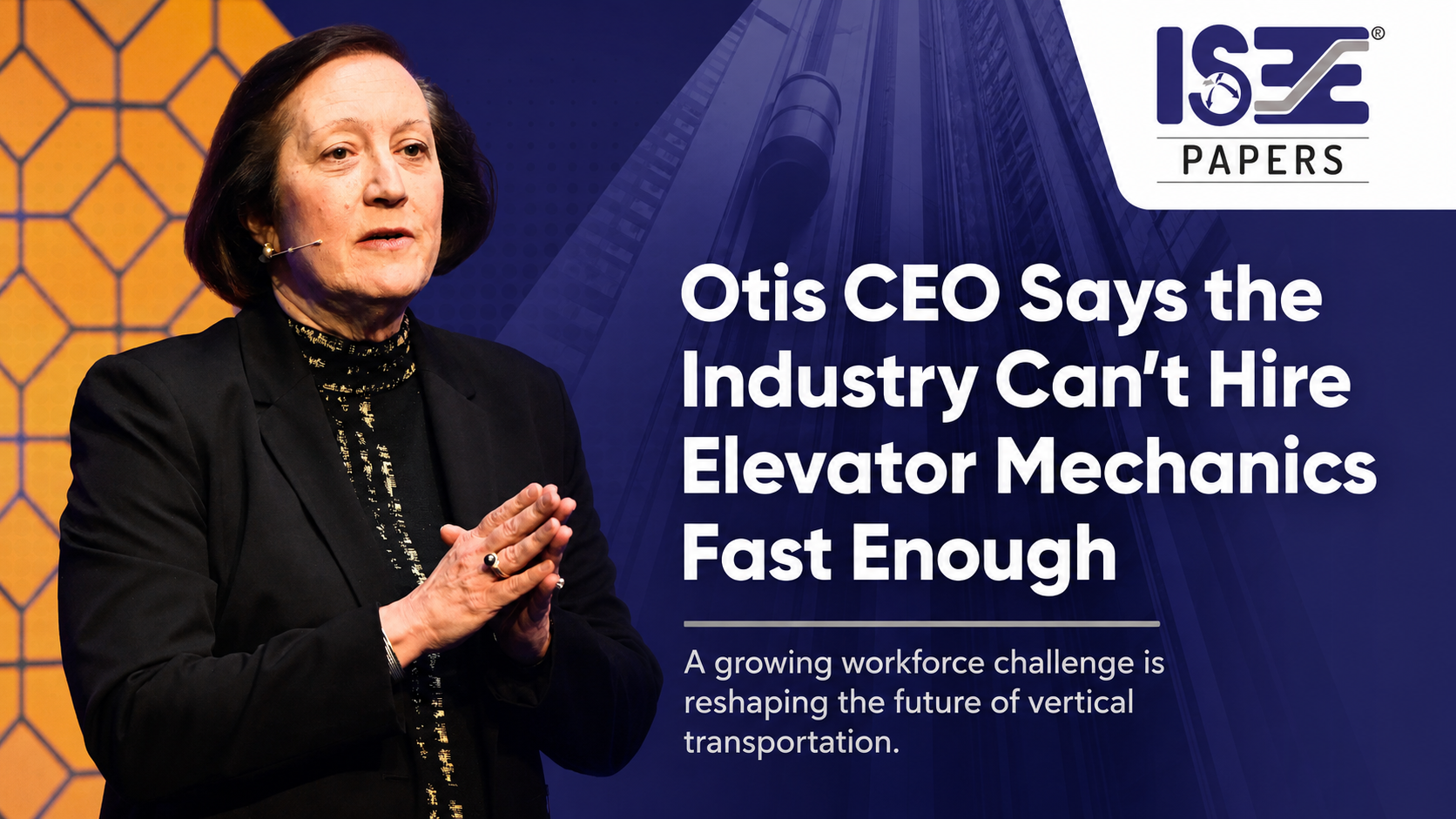
Otis CEO Says the Industry Can’t Hire Elevator Mechanics Fast Enough
At a time when industries are openly discussing layoffs, automation, and shrinking workforces, the vertical transportation industry is facing a very different challenge: it does not have enough skilled hands.
Elevator mechanics, once seen as a behind-the-scenes trade, are now emerging as one of the most valuable roles in the built environment. According to a recent Business Insider report, Otis CEO Judy Marks said the company cannot hire elevator mechanics fast enough, with demand for field professionals continuing to rise globally.
Otis currently has around 45,000 mechanics, up from about 40,000 when it became an independent company in 2020. This is not just a hiring story. It is a signal of where the elevator and escalator industry is headed.
Technology Is Rising, But Human Skill Still Matters
For years, conversations around vertical transportation have focused heavily on product innovation: faster elevators, smarter dispatch systems, AI-based monitoring, destination control, IoT integration, and energy-efficient drives.
All of these matter. But the latest workforce trend reminds the industry of something more fundamental.
No matter how smart a system becomes, it still needs trained people to install it, maintain it, inspect it, modernize it, and keep it safe.
Elevator mechanics occupy a rare place in today’s job market. Their work is technically demanding, physically intensive, and deeply tied to safety regulations. It is not a role that can be easily automated.
Marks described elevator service as “truly a craft skill,” requiring years of training and hands-on experience.
One of the Highest-Paid Skilled Trades
That craft is now being rewarded.
The report notes that elevator and escalator installers and repairers earned an average annual wage of $109,820 in May 2025 in the United States, with the 90th percentile reaching $158,890. This places elevator mechanics among the highest-paid skilled trades in the construction and extraction category.
But the bigger story is not only about salaries. It is about industry structure.
The Industry Is Moving Toward Lifecycle Value
The vertical transportation business is steadily shifting from a new-installation-led model to a lifecycle-led model.
As buildings age and urban density increases, the demand for maintenance, repair, safety upgrades, and modernization is becoming more important. A new elevator may be installed once, but it must be serviced for decades.
That makes the mechanic central to the entire value chain.
In mature markets, refurbishment and modernization are creating consistent demand. In growing markets, new construction, metro networks, mixed-use developments, high-rise housing, hospitals, airports, and commercial towers are expanding the installed base.
Every new installation adds another long-term service obligation.
Why This Matters for India
This is especially relevant for countries like India, where vertical growth is moving beyond metros into Tier-2 and Tier-3 cities.
As the number of elevators and escalators increases, the industry will need not only more equipment, but more trained professionals capable of supporting that equipment safely.
The challenge is clear: the industry cannot grow sustainably without investing in people.
Training academies, apprenticeship models, certification systems, safety education, and long-term career pathways will become critical. In the United States, mechanics often begin through structured apprenticeship routes, combining field work with technical schooling before achieving journeyman status.
The Next Big Race May Be for Talent
For India and other high-growth markets, this opens an important conversation.
Are we building enough technical talent for the next phase of vertical transportation growth? Are developers, OEMs, consultants, contractors, and regulators treating maintenance skill as seriously as installation capacity? Are young workers being shown that this is not just a trade, but a long-term technical career?
The answer will shape the future of the sector.
The elevator mechanic shortage also carries a message for the smart-building era. Technology may make elevators more connected, but human expertise will remain the backbone of reliability.
Predictive maintenance can identify a problem. Remote monitoring can flag an issue. But when safety, repair, calibration, and compliance are involved, skilled professionals still matter.
The industry often speaks about moving people. But increasingly, its own movement depends on how well it can attract, train, and retain the people who keep buildings moving.
For vertical transportation, the next big race may not be only for market share, speed, or technology.
It may be for talent.
Source Credit: Based on reporting by Business Insider on Otis CEO Judy Marks and the rising demand for elevator mechanics.
Disclaimer: This article is published for informational and editorial purposes only. Views expressed may not reflect those of ISEE Papers. We do not guarantee accuracy or completeness. For full details, please read our complete disclaimer here: ISEE Papers Website Disclaimer