


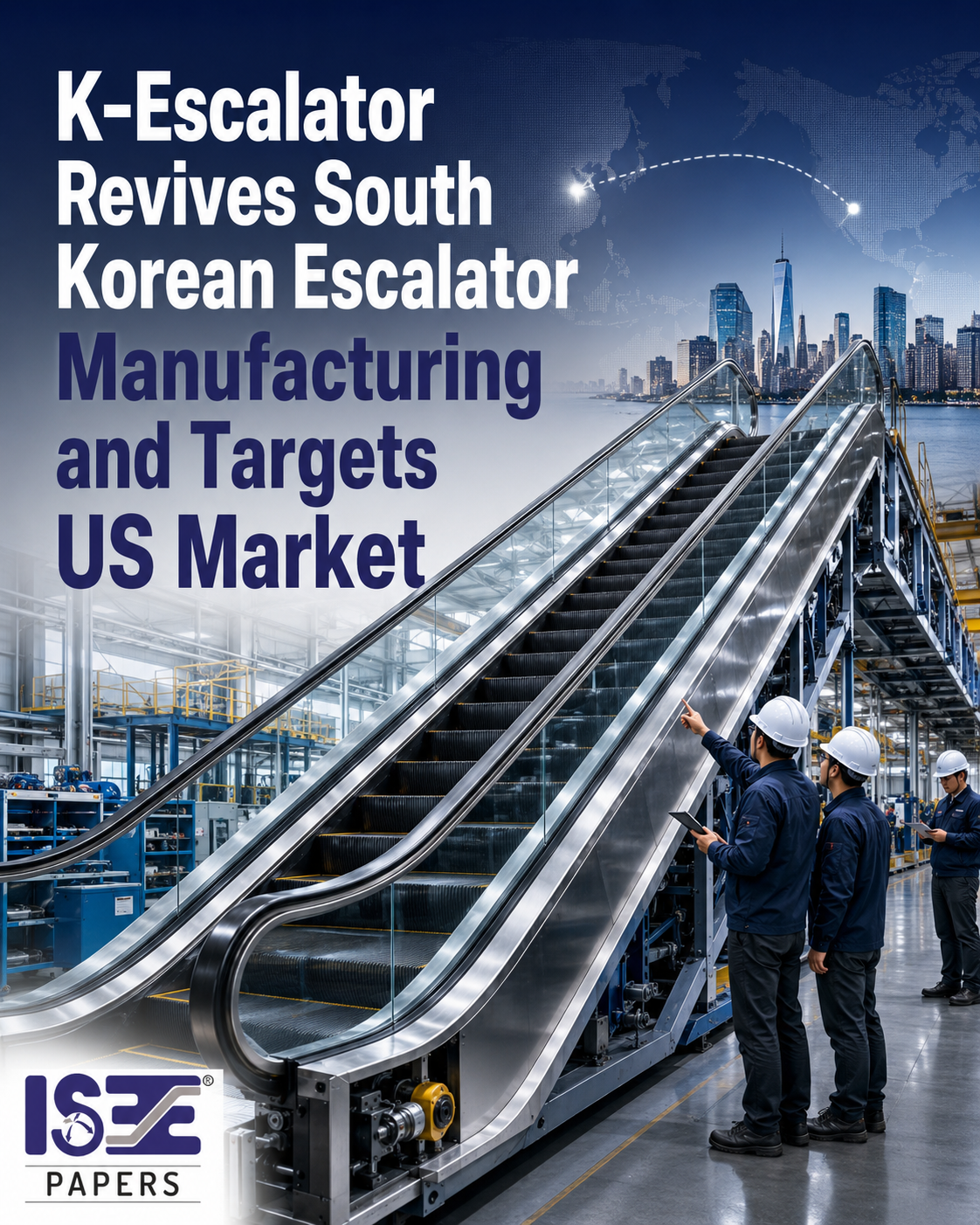
South Korea has resumed domestic escalator manufacturing after a gap of approximately ten years, with K-Escalator securing approval to produce systems designed for installations up to 21 metres high.
The certification from the Korea Elevator Safety Agency represents an important milestone for the company, which was established in 2024 by Hyundai Elevator Service and a group of small and medium-sized elevator industry businesses.
K-Escalator operates from Geochang County in South Gyeongsang Province, an area developed as a specialised cluster for South Korea’s elevator industry. A full-scale 21-metre escalator installed at the company’s manufacturing facility was used during the certification process.
The approval enables K-Escalator to manufacture a wider range of escalators for transport infrastructure, commercial buildings, public facilities and modernisation projects within South Korea.
Rebuilding domestic manufacturing capacity
South Korea’s escalator manufacturing ecosystem began contracting during the 2000s as lower-priced imported products gained a larger share of the domestic market. Hyundai Elevator, the country’s last major domestic producer at the time, stopped manufacturing escalators locally in 2014.
The decade-long production gap affected more than manufacturing capacity. Experienced engineers moved to other areas of the industry, several component suppliers exited the market and fewer young technicians entered the escalator manufacturing profession.
K-Escalator was created to help rebuild this industrial base by combining Hyundai Elevator Service’s market and service capabilities with the specialised knowledge of smaller Korean manufacturers.
The company began delivering its first escalators in 2025 and generated revenue of approximately 4.5 billion won, equivalent to around US$3.2 million, during the year. Korea JoongAng Daily
Safety and parts availability support the revival
The return of local production comes amid concerns about the availability, traceability and compatibility of replacement components for imported escalators.
South Korean transport operators have become heavily dependent on imported escalators and components over the past decade. Maintenance can become more difficult when replacement parts are unavailable locally or take longer to reach operators.
Past incidents have also increased scrutiny of imported components. In 2013, an escalator at Yatap Station unexpectedly reversed direction, injuring 39 people. Another reverse-running incident at Sunae Station in 2023 injured 14 passengers and renewed discussion about the country’s reliance on overseas escalator parts. The Korea Times
By restoring domestic production, K-Escalator aims to create a more reliable local supply chain while improving access to compatible components, technical support and maintenance services.
Replacement demand presents an opportunity
A considerable number of escalators installed in South Korea’s shopping centres, railway stations and subway networks during the 1990s and early 2000s are now approaching the stage at which replacement or extensive modernisation may be required.
This ageing installed base could create opportunities for domestic manufacturers. However, K-Escalator continues to face significant price competition from imported products, particularly in privately funded projects.
The company had expected annual demand from public-sector replacement programmes to reach approximately 400 units. The current market has reportedly remained below 200 units a year as economic conditions have delayed or reduced investment in public infrastructure.
Another challenge is the shortage of skilled manufacturing personnel. Much of the country’s escalator expertise remains concentrated among older engineers, making the recruitment and training of younger technicians important to the long-term survival of the domestic industry.
North American certifications underway
Alongside developing its South Korean business, K-Escalator has started seeking the certifications required to enter the North American market.
The company believes Korean-manufactured equipment could find opportunities in the United States, where changing trade conditions and higher barriers for some Chinese manufacturers are reshaping the competitive environment.
Securing North American approvals would give K-Escalator access to a significantly larger market, particularly across public transportation, commercial infrastructure and replacement projects.
The company’s progress marks the beginning of a broader attempt to restore South Korea’s escalator manufacturing capabilities. Its long-term success will depend on its ability to compete on price, rebuild technical skills, secure a stable pipeline of domestic projects and meet the regulatory requirements of international markets.