







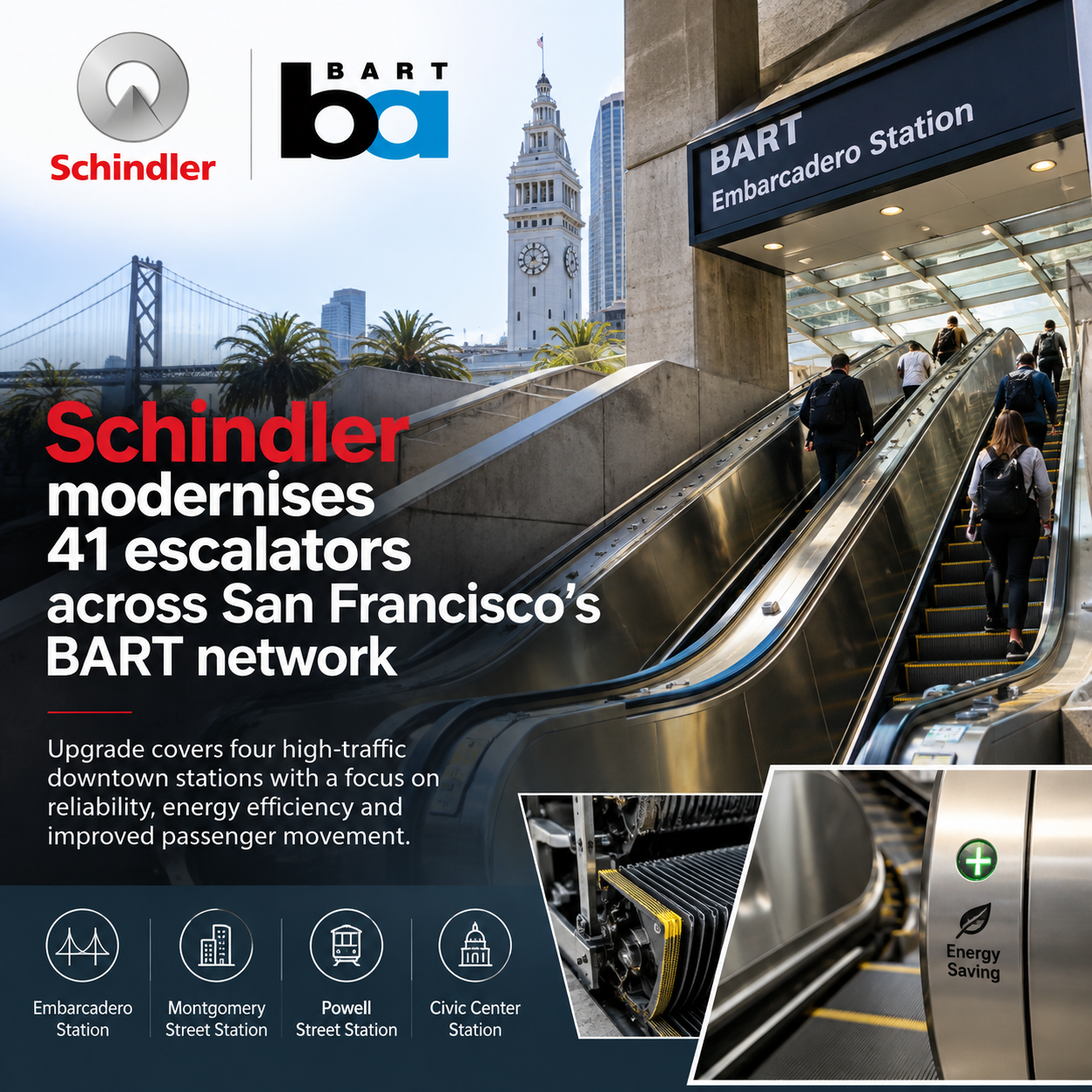
Schindler has highlighted its ongoing work with the Bay Area Rapid Transit (BART) network in San Francisco, where the company is modernising 41 escalators across four of the transit system’s busiest downtown stations.
The large-scale infrastructure programme covers Embarcadero, Montgomery Street, Powell Street and Civic Center stations, all located beneath Market Street in central San Francisco. These stations are among the busiest in the BART network by passenger volume.
The modernisation programme has been underway since 2020, with Schindler teams working within the constraints of an active underground public transport network. The project involves not only upgrading escalator equipment but also managing complex logistics, confined working environments and passenger safety while the stations continue to operate.
Focus on Reliability and Passenger Movement
Reliable escalator access plays an important role in moving passengers efficiently between street level and BART platforms, particularly at high-traffic downtown stations.
In Schindler’s latest project update, Mark Dana, Project Manager at BART’s Office of Infrastructure Delivery, highlighted the close coordination between BART management, Schindler and on-site teams throughout the programme.
According to the update, the collaborative approach has allowed the teams to identify potential issues early and respond more effectively to unexpected situations during construction and modernisation work.
The scale of BART’s passenger operations makes reliability particularly important. BART told Schindler that ridership is approaching the levels recorded before the COVID-19 pandemic, when the metro system carried an average of more than 400,000 passengers per day.
Sustainability Built Into the Upgrade
Sustainability is also a key component of the modernisation programme.
BART sought escalators equipped with energy-saving regenerative drives and eco-mode functionality, technologies designed to improve energy efficiency during operation. The transit authority also highlighted the importance of using multiple units with interchangeable parts, helping simplify procurement and enabling faster replacement of components when required.
This approach reflects a broader shift in major transit infrastructure projects, where escalator modernisation increasingly extends beyond replacing ageing equipment to improving energy efficiency, maintainability, reliability and lifecycle performance.
Modernising Critical Urban Infrastructure
The BART project demonstrates the engineering challenges associated with modernising vertical transportation systems inside existing underground transit infrastructure.
Schindler has previously noted that technicians are required to work within extremely confined spaces while handling wiring, electronics and other equipment. The project also involves supporting works such as installing barriers and maintaining safe passenger movement around active construction areas.
For BART, the programme represents an investment in infrastructure that thousands of passengers depend on every day. For the elevator and escalator industry, it highlights the growing importance of modernisation as major cities seek to extend the life of existing transportation assets while improving reliability, sustainability and passenger experience.
With 41 escalators across four high-traffic stations, the Market Street programme stands as a significant example of escalator modernisation within a major urban transit network.
Source: Schindler Group, San Francisco BART: A Smooth Partnership
Image/Information Courtesy: Schindler Group