









The Rise of "Digitally Native" High-Rises: Vertical Mobility in the AI Era
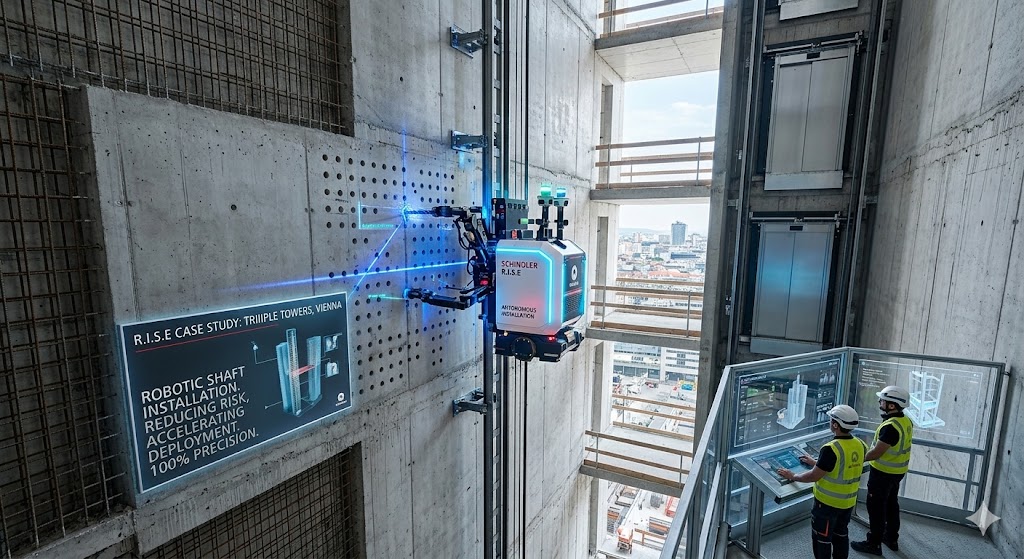
VIENNA, AUSTRIA — In early 2026, the vertical transportation industry reached a significant milestone in “Engineering” and “Safety” with the successful completion of the TrIIIple Towers project. While the skyline addition is impressive, the real news lies in how it was built. Schindler utilized its revolutionary R.I.S.E (Robotic Installation System for Elevators), marking a transition toward fully autonomous construction in high-rise shafts.
The Engineering: The Self-Climbing Robot
Traditionally, elevator installation is one of the most physically demanding and repetitive jobs in construction, requiring technicians to drill thousands of anchor bolts into concrete while suspended in a dark, narrow shaft.
The R.I.S.E system is an autonomous, self-climbing robot that operates independently within the hoistway.
-
Precision Drilling: Using data directly from Building Information Modeling (BIM) files, the robot identifies the exact coordinates for landing doors and divider beams.
-
24/7 Operation: Unlike human crews, the robot can operate around the clock, significantly accelerating the “Modernization” and “Installation” phases of the project.
Safety: Eliminating High-Risk Labor
The primary driver behind the adoption of R.I.S.E in 2026 is the enhancement of Safety. By delegating the high-decibel, high-vibration task of concrete drilling to a machine, the industry is seeing:
-
Reduced Injury Rates: Technicians are moved from the high-risk “inside-shaft” environment to supervisory roles in a safe control room.
-
Quality Consistency: Human error in bolt placement—which can lead to ride quality issues or expensive rework—is virtually eliminated.
The Impact: A Global Deployment
Following the success in Vienna, major developers in Riyadh and Mumbai have begun mandating robotic installation for all projects over 200 meters. For the VT industry, this represents a shift toward Mobility-as-a-Service that begins before the building is even open. By integrating robotics with digital twins, the “Engineering” of 2026 is no longer just about the car in the shaft, but the intelligent systems that put it there.
This article is published for informational and editorial purposes only. Views expressed may not reflect those of ISEE Papers. We do not guarantee accuracy or completeness. For full details, please read our complete disclaimer here: https://iseepapers.com/isee-papers-website-disclaimer/