










The Digital Lift: Virtual Maintenance Redefining the Service Grid
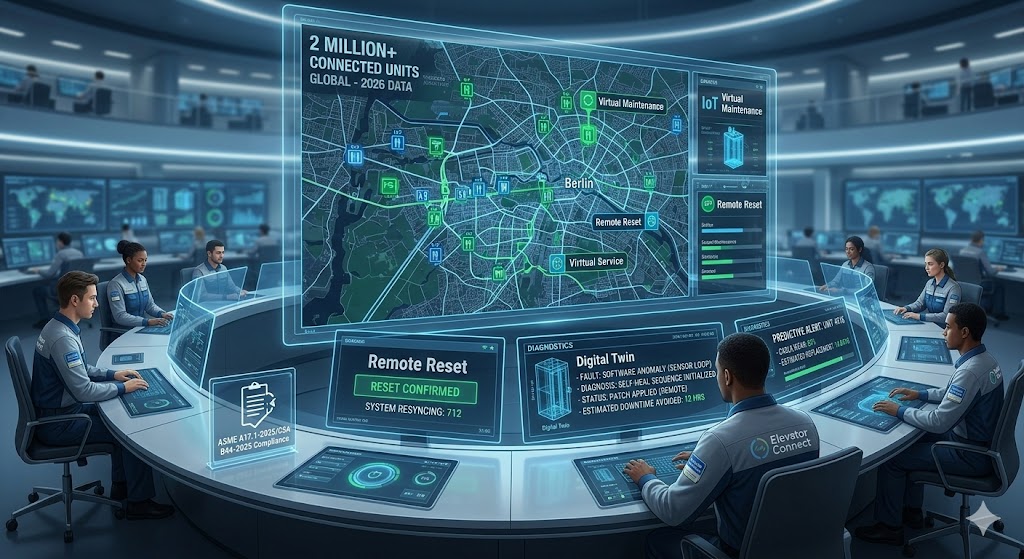
BERLIN, GERMANY — In the first half of 2026, the vertical transportation (VT) industry has officially crossed a digital rubicon. The “technician in the shaft” model—a century-long staple of urban maintenance—is being rapidly supplemented by Cloud-Based Remote Operations. According to recent industry data, over 2 million elevator and escalator units globally are now permanently tethered to IoT ecosystems like Otis MAX and Schindler Ahead.
The News: A Global Network of Connected Shaffts
The scale of the “Connectivity” shift is staggering. Otis, which currently holds nearly 32% of the remote monitoring market share, has successfully integrated AI-driven diagnostics into its global service portfolio. By 2026, these cloud platforms are no longer just sending “broken” alerts; they are managing the heartbeat of entire city districts.
-
Market Growth: The elevator remote monitoring market has surged, driven by a 2026 push for “Smart City” infrastructure.
-
Global Leaders: Alongside Otis and Schindler, Asian giants like Hitachi and Hyundai Elevator (the latter serving 85% of South Korean installations) have turned elevators into data-generating assets that communicate with building management systems in real-time.
Innovation: The Rise of the “Remote Reset”
The most transformative “Intelligence” feature of 2026 is the Remote Interaction Operation. Previously, any minor sensor glitch—such as a door obstruction or a brief power surge—required a physical visit from a technician. Now, under the updated ASME A17.1-2025/CSA B44-2025 safety codes, qualified service teams can perform “Remote Resets” and software patches from centralized operations centers.
-
Self-Correction: If an elevator identifies a minor non-safety-critical software loop, it can often initiate a “self-heal” sequence.
-
Downtime Reduction: These virtual interventions have reduced physical call-outs by up to 20%, and in some high-density commercial zones, unscheduled downtime has plummeted by 50%.
-
Software Patches: Just like a smartphone, elevators in 2026 receive over-the-air (OTA) updates to optimize speed profiles and energy usage without a single minute of “out of service” time.
The Impact: From Reactive to Predictive
The “Modernization” of maintenance is fundamentally changing the economics of building ownership. By shifting from Time-Based Maintenance (checking things because the calendar says so) to Condition-Based Maintenance (checking things because the data shows wear), the industry is extending component lifespans by an estimated 30%.
As we move deeper into 2026, the goal is clear: a “Zero-Failure” future. For the millions of daily passengers, this means the most reliable elevator is the one they never have to think about—because the “technician” fixed it from a cloud server three hours before a human ever noticed a problem.
This article is published for informational and editorial purposes only. Views expressed may not reflect those of ISEE Papers. We do not guarantee accuracy or completeness. For full details, please read our complete disclaimer here: https://iseepapers.com/isee-papers-website-disclaimer/