



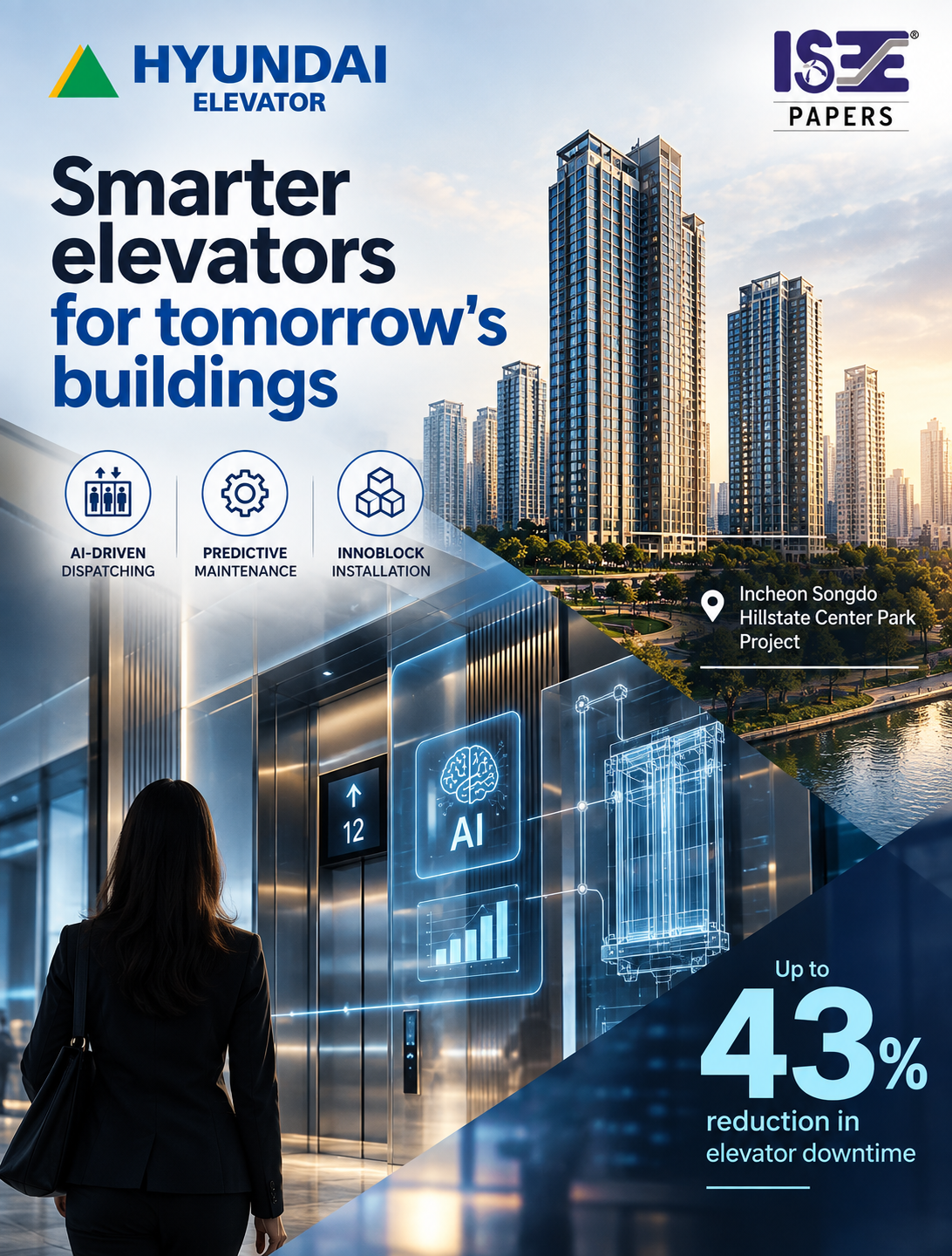
Hyundai Elevator is strengthening its focus on artificial intelligence and smart maintenance technologies as it looks to improve elevator efficiency, reliability and installation processes across increasingly complex high-rise developments.
The South Korean elevator manufacturer is highlighting AI-driven group control technology that analyses building traffic patterns and optimises elevator dispatching accordingly. The system is designed to determine how elevators within a group should respond to passenger demand, helping improve overall traffic flow and reduce unnecessary waiting.
AI Takes a Larger Role in Elevator Operations
Traditional elevator group control systems typically operate according to predefined algorithms and real-time calls. Hyundai Elevator’s approach incorporates AI-based analysis to better understand traffic patterns and allocate elevators based on changing demand.
This becomes particularly relevant in large residential, commercial and mixed-use developments where passenger movement can vary significantly throughout the day.
Morning departures, office arrival periods, lunchtime traffic and evening peaks can create very different demands on an elevator system. By analysing these patterns, intelligent dispatching systems can make more informed decisions about which elevator should respond to each call.
The wider objective is to improve passenger handling while using the available elevator capacity more efficiently.
Predictive Maintenance Before a Breakdown Occurs
Another major area of development is predictive maintenance.
Instead of relying primarily on scheduled inspections or responding after equipment develops a fault, smart maintenance systems continuously analyse elevator operating data to identify signs of potential problems.
Changes in equipment behaviour can provide early indications that individual components may require inspection or maintenance. This gives service teams an opportunity to intervene before an issue develops into an unexpected shutdown.
According to the report, the application of smart maintenance technologies can reduce elevator downtime by as much as 43%.
For building owners and facility managers, reducing unplanned downtime is particularly important in high-rise buildings where elevators are critical infrastructure rather than simply another building service.
Predictive maintenance can also help maintenance teams prioritise interventions based on actual equipment condition, supporting a shift from reactive servicing towards more data-driven asset management.
InnoBlock Brings Modular Thinking to Elevator Installation
Hyundai Elevator is also applying innovation to the installation process through its InnoBlock modular construction approach.
The technology is being deployed at the Incheon Songdo Hillstate Center Park project in South Korea.
InnoBlock uses a modular approach in which key elevator installation elements can be prepared in advance rather than relying entirely on conventional on-site assembly. The method is intended to improve installation efficiency while providing greater consistency in the construction process.
The development reflects a broader movement towards industrialised and modular construction methods across the building sector, particularly as developers look for ways to improve productivity, quality control and project timelines.
Elevators Are Becoming Data-Driven Building Systems
Hyundai Elevator’s developments illustrate how the elevator industry’s technology focus is expanding beyond speed, capacity and mechanical performance.
AI-based dispatching addresses how passengers move through buildings. Predictive maintenance addresses how equipment performance is monitored throughout its operating life. Modular installation addresses how elevators can be integrated more efficiently during construction.
Together, these technologies point towards elevators becoming increasingly connected and data-driven components of modern buildings.
For developers and building operators, the value of these systems could extend beyond passenger convenience. Better traffic management, earlier identification of maintenance requirements and reduced downtime can influence the overall operational performance of a building.
As high-rise developments become larger and passenger movement becomes more complex, intelligent elevator management is likely to play an increasingly important role in vertical transportation.
Source: Kyunghyang Shinmun, September 25, 2026