










Korea Lift Safety Institute Backs Two-Line Escalator Riding to Improve Safety and Crowd Movement
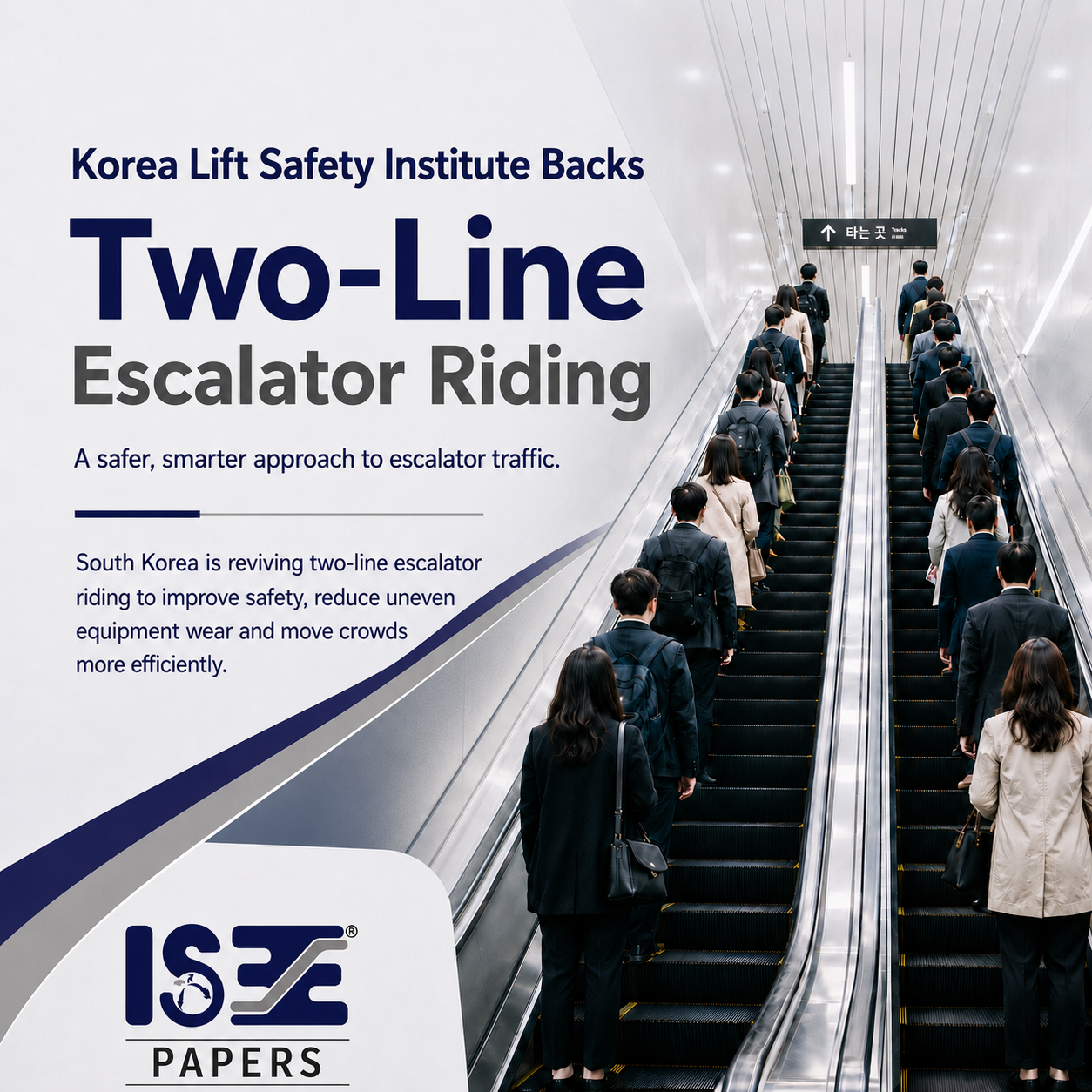
South Korea is reviving its two-line escalator riding campaign after 11 years, reopening a major public debate on safety, machine wear and transport efficiency in busy public spaces.
South Korea is bringing back its two-line escalator riding campaign, a move backed by the Korea Lift Safety Institute and supported by experts who say the practice can help reduce accidents, limit uneven mechanical wear and improve crowd flow.
The campaign returns after 11 years and comes at a time when the country is once again debating whether passengers should stand on one side of an escalator or use both sides. For decades, many commuters have followed the habit of standing on one side while leaving the other side open for people who want to walk.
While this habit has often been seen as considerate, experts now say it creates a safety and efficiency problem. The concern is not only about how people move, but also about how escalators are designed to carry weight.
The key message is simple: two-line riding can make escalators safer for passengers, healthier for machines and more efficient during crowded periods.
A Policy That Has Changed Direction Before
South Korea’s escalator policy has shifted several times over the years. Single-line riding was recommended in the late 1990s. The country returned to two-line riding in 2007, before the campaign was eventually scrapped in 2015.
The latest revival is being described as a science-based decision rather than a simple etiquette campaign. Experts believe the change is necessary because the long-standing single-line habit has placed repeated stress on escalators and may have increased the risk of accidents.
Why Single-Line Riding Can Damage Escalators
Mechanical engineers warn that escalators are precision machines designed to carry loads evenly across both sides. When most passengers stand on one side and the other side is used for walking, the machine experiences uneven loading.
Kim Eui-soo, professor of mechanical engineering at Korea National University of Transportation, explained that continued single-line riding can cause one-sided wear of rollers and rails, along with unequal elongation between the left and right chains. Over time, these issues can increase the risk of serious mechanical failure.
Another concern is dynamic load. When a person stands still, the load on the escalator is treated as a normal static load. But walking can raise the load to around three times that level, while running can increase it to nearly seven or eight times. This repeated impact can accelerate metal fatigue and place extra stress on the escalator system.
Escalators are designed to move people safely, not to function as running tracks.
Expert view highlighted in the reportThe Efficiency Debate
Supporters of single-line riding often argue that keeping one side open helps people move faster. However, studies and crowd-flow experts suggest that this may not be true during busy periods.
In practice, only about 25% of subway users walk on escalators. This means the standing side carries most passengers, while the walking side often remains underused. The result is a crowded standing lane and an inefficiently used walking lane.
Michael Foo, a professor of mechanical engineering at the University of Maryland who studies crowd flow on escalators, noted that reserving one lane only for walkers creates a resource imbalance. Since the majority of passengers stand, using only one lane for them reduces the total movement capacity of the escalator.
Single-Line Riding
One side becomes crowded, the walking lane is underused and uneven load can increase mechanical stress on escalator parts.
Two-Line Riding
Both sides are used, weight is distributed more evenly and more people can move through the escalator during peak congestion.
What Global Examples Show
International examples support the idea that two-line riding can improve passenger movement in crowded systems. In 2016, an experiment at Holborn Station on the London Underground showed that asking passengers to stand on both sides increased carrying capacity by about 30% during the same time period.
Taipei introduced two-line escalator riding in 2005 and is often cited as a successful example in Asia. In Japan, Saitama Prefecture introduced an ordinance in 2021 that reduced walking on escalators by 20%. However, because the rule did not include penalties, old behaviour gradually returned within a year.
Researchers in Japan and China have also found that two-line riding becomes more beneficial as congestion increases. A 2020 statistical physics model by a Japanese research team and a 2018 simulation study by a Chinese group both reached similar conclusions.
Experts Call for Flexible Rules
Experts believe the success of South Korea’s campaign will depend on enforcement and practical design. Some have suggested that local ordinances with meaningful penalties may be needed if awareness campaigns alone do not change public behaviour.
However, many also believe that a rigid one-size-fits-all rule may not be ideal. Instead, they recommend a conditional approach based on congestion levels, escalator length and real-time passenger flow.
Use two-line riding during peak congestion to increase carrying capacity and reduce bottlenecks.
Encourage passengers not to walk or run on escalators, especially in crowded stations.
Consider traffic light-style guidance that advises passengers based on real-time crowd conditions.
Support awareness campaigns with stronger local enforcement where needed.
The Bigger Message
South Korea’s renewed two-line escalator campaign is not only about changing commuter etiquette. It is about using safety data, engineering evidence and crowd-flow science to reduce accidents, protect equipment and move people more efficiently in public transport spaces.