









India’s Elevator Market: Foreign Revenue Leaders, Indian Installation Strength
Four of India’s top five lift makers by FY25 revenue are foreign-owned. But the company leading by units installed is Indian. That difference reveals how layered India’s elevator market really is.
4 of India’s top 5 lift makers are foreign-owned.
Finland. USA. Switzerland. Germany. The only Indian company in the top five is Johnson Lifts, a Chennai family business founded in 1963.
India’s vertical transportation market is expanding with the country’s skyline. From metro stations and hospitals to malls, offices, airports, and residential towers, elevators are now central to how modern India moves.
But behind this growth lies a striking market pattern. The highest revenue positions are largely held by global companies, while one of the strongest installation stories belongs to an Indian manufacturer.
According to FY25 revenue data sourced from Tofler, CARE Ratings, and MCA filings, nearly 85% of India’s estimated ₹16,000 crore elevator market is concentrated among just five companies.
The Top 10 Lift Makers in India by FY25 Revenue
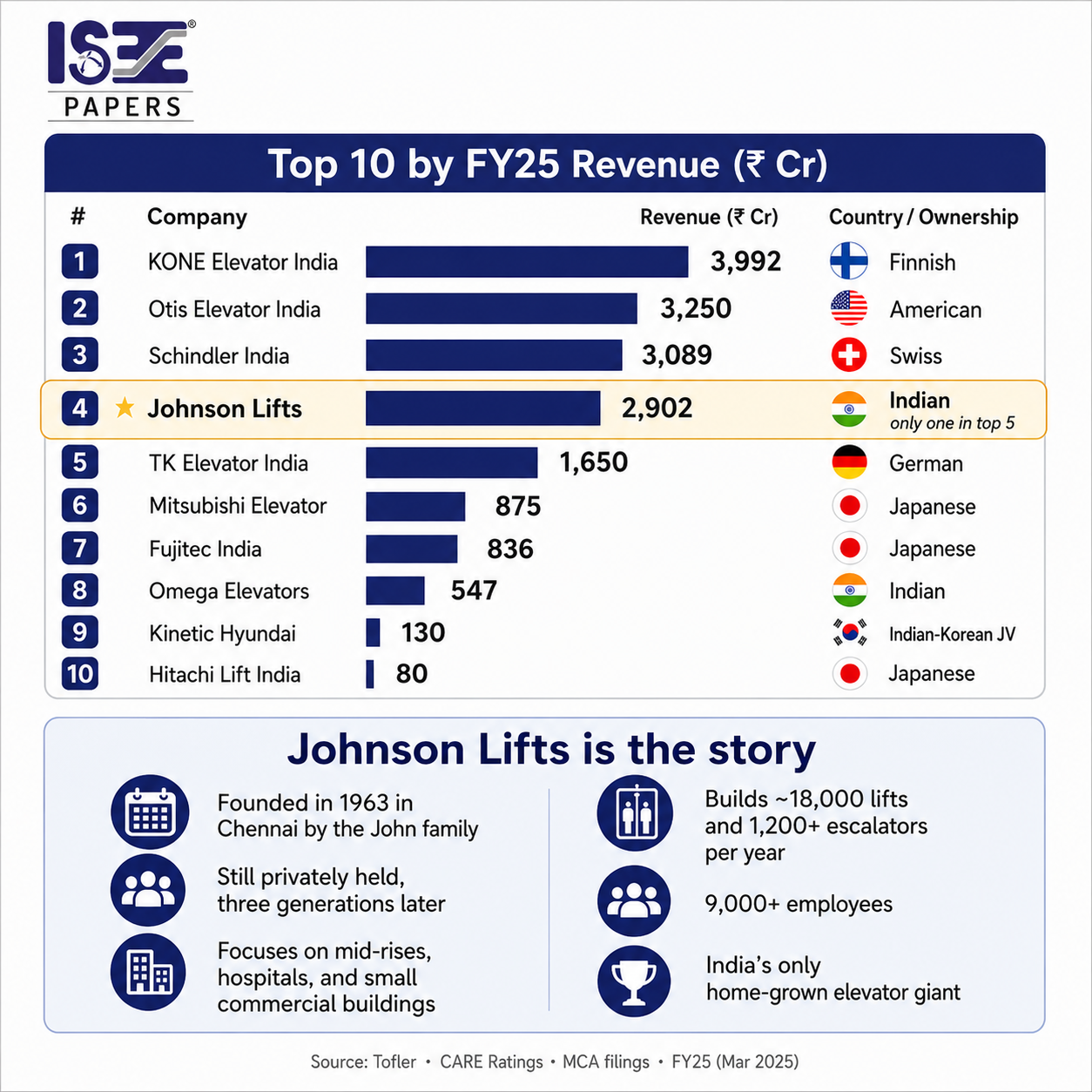
The revenue table shows a clear global presence at the top of India’s elevator market. KONE Elevator India leads by FY25 revenue, followed by Otis Elevator India, Schindler India, Johnson Lifts, and TK Elevator India.
| # | Company | FY25 Revenue | Country / Ownership |
|---|---|---|---|
| 1 | KONE Elevator India | ₹3,992 Cr | Finnish |
| 2 | Otis Elevator India | ₹3,250 Cr | American |
| 3 | Schindler India | ₹3,089 Cr | Swiss |
| 4 | Johnson Lifts Only Indian in Top 5 | ₹2,902 Cr | Indian |
| 5 | TK Elevator India | ₹1,650 Cr | German |
| 6 | Mitsubishi Elevator | ₹875 Cr | Japanese |
| 7 | Fujitec India | ₹836 Cr | Japanese |
| 8 | Omega Elevators | ₹547 Cr | Indian |
| 9 | Kinetic Hyundai | ₹130 Cr | Indian-Korean JV |
| 10 | Hitachi Lift India | ₹80 Cr | Japanese |
Revenue Leadership vs Installation Leadership
One of the most interesting parts of India’s elevator market is that leadership changes depending on what is being measured.
KONE leads by revenue. Johnson Lifts leads by units installed.
This makes the Indian market more layered than a simple revenue ranking. Global brands dominate much of the premium revenue pool, especially in high-rise buildings, commercial towers, luxury developments, and large infrastructure projects.
Indian manufacturers, meanwhile, continue to hold strong ground across everyday vertical mobility needs such as mid-rise residential buildings, hospitals, smaller commercial buildings, and regional infrastructure.
In short, India installs a large number of Indian lifts, but pays higher values for many foreign-owned systems.
Johnson Lifts: India’s Home-Grown Elevator Giant
Johnson Lifts stands out because it is the only Indian company among the top five by FY25 revenue.
Founded in Chennai in 1963 by the John family, the company remains privately held and family-led three generations later. Unlike some global players that are closely associated with landmark towers and premium commercial projects, Johnson Lifts has built its scale through a much wider base of practical Indian demand.
The company’s strength lies in the places where India’s elevator requirement is most consistent: mid-rise buildings, hospitals, small commercial properties, apartment blocks, and institutional projects.
Its market position is not built only on visibility. It is built on reach, service, installation volume, and a deep understanding of Indian building conditions.
A Market Dominated by Global Ownership
Eight of the top 10 companies are foreign-controlled or joint ventures. Only two, Johnson Lifts and Omega Elevators, are purely Indian.
That does not make the foreign presence unusual. Elevators are a technology-heavy sector requiring advanced safety systems, control mechanisms, testing standards, manufacturing precision, maintenance networks, and long-term service reliability.
Global players bring decades of experience, established technology platforms, and international project credibility.
Otis, for instance, has been present in India since 1953. Globally, it is associated with iconic structures such as the Empire State Building, where Otis elevators were installed in 1931. TK Elevator is known for innovations such as MULTI, the world’s first rope-less elevator system.
These companies bring global engineering heritage into India’s rapidly urbanizing built environment. But the Indian story is equally important.
Johnson Lifts shows that domestic manufacturers can compete at scale, especially when they build for Indian conditions, Indian price expectations, Indian service needs, and Indian building typologies.
Foreign brands lead much of the revenue table. Indian companies continue to power a large part of everyday lift installation.
What This Means for India’s Vertical Transportation Industry
India’s elevator market is not just about who sells the most expensive systems or who installs the most units. It reflects a broader reality of the country’s infrastructure growth.
Premium urban projects continue to favour global brands. Mass-market installation volume continues to create room for strong Indian companies. Both segments are growing, but they follow different economics.
This is why the gap between revenue leadership and unit leadership matters.
It shows that India’s vertical transportation industry is not one market. It is many markets operating together: luxury towers, affordable housing, hospitals, railway and metro infrastructure, malls, offices, small commercial buildings, public projects, and regional real estate.
Each of these demands different price points, service models, engineering requirements, and brand expectations.
The Bigger Question for Indian Manufacturing
The elevator industry raises an important question for Indian manufacturing: can India produce more home-grown companies that lead not only by volume, but also by revenue, technology, and premium positioning?
Johnson Lifts has already shown that an Indian company can build national scale in a sector historically dominated by global names. Omega Elevators also represents another domestic player in the top 10.
The next phase of the industry may depend on how Indian manufacturers move up the value chain: smarter systems, better design, stronger safety standards, predictive maintenance, destination control, energy efficiency, and premium project capability.
India’s buildings are getting taller. Its public infrastructure is getting larger. Its cities are getting denser.
The companies that can combine engineering, service depth, affordability, and trust will shape the next decade of vertical transportation.
For Now, the Market Tells a Clear Story
Foreign-owned brands dominate India’s elevator revenue table. Indian manufacturers continue to hold strong ground in installation volume and everyday project demand.
Johnson Lifts remains the strongest home-grown elevator story in India’s top tier, not because it mirrors global brands, but because it has built scale around the way India actually builds.
Source: Tofler, CARE Ratings, MCA filings, FY25, March 2025.