
ISEE Papers

Johnson Lifts Acquires 39 Acres Near Chennai to Power Future Elevator Manufacturing

Johnson Lifts Acquires 39 Acres Near Chennai to Power Future Elevator Manufacturing Johnson Lifts is preparing for its next phase of manufacturing expansion with a major land acquisition near Chennai. The Chennai-based elevator manufacturer has acquired 39 acres of land at Sengadu for ₹125 crore. The move forms part of the company’s long-term plan to strengthen production capacity and build future-ready capabilities in India’s vertical transportation sector. Advertisement The proposed facility is expected to support the manufacturing of high-speed elevators, a segment that is gaining relevance as India’s built environment continues to expand upward through residential towers, commercial developments, infrastructure projects, and large public mobility spaces. According to the information shared by the company, the first phase of the project is expected to involve an investment of around ₹200 crore. This includes the cost of land acquisition, which was facilitated by JLL, along with equipment required for the initial phase. Construction Expected to Begin in 2028 Construction at the Sengadu site is expected to begin in 2028. Before that, Johnson Lifts is focusing on expanding its existing manufacturing facility, which is expected to be completed by September 2027. The upcoming unit will primarily focus on high-speed elevators. A part of the company’s escalator production is also expected to be shifted to the new facility, helping improve operational efficiency and increase overall capacity. Advertisement A Capacity Signal for India’s Vertical Transportation Industry For Johnson Lifts, the acquisition marks a significant step in preparing for future demand. As India continues to invest in real estate, infrastructure, metro systems, airports, commercial spaces, and urban development, the need for reliable elevator and escalator manufacturing capacity is expected to grow. The Sengadu expansion reflects how domestic manufacturers are preparing for this next phase of demand, not only by increasing production but also by focusing on more advanced vertical transportation systems. At a time when the elevator and escalator industry is closely linked with the pace of urban growth, Johnson Lifts’ 39-acre acquisition signals confidence in India’s long-term manufacturing and infrastructure story. Disclaimer: This article is published for informational and editorial purposes only. Views expressed may not reflect those of ISEE Papers. We do not guarantee accuracy or completeness. For full details, please read our complete disclaimer here: ISEE Papers Website Disclaimer “`

Top Lift Companies in India by Revenue FY25 | ISEE Papers

Market Analysis | Vertical Transportation India’s Elevator Market: Foreign Revenue Leaders, Indian Installation Strength Four of India’s top five lift makers by FY25 revenue are foreign-owned. But the company leading by units installed is Indian. That difference reveals how layered India’s elevator market really is. By ISEE Papers Editorial Desk Vertical Transportation Industry FY25 Revenue Analysis 4 of India’s top 5 lift makers are foreign-owned. Finland. USA. Switzerland. Germany. The only Indian company in the top five is Johnson Lifts, a Chennai family business founded in 1963. ₹16,000 Cr Estimated size of India’s elevator market. ~85% Market concentration among just five companies. ₹14,232 Cr Combined FY25 revenue of the top five companies. India’s vertical transportation market is expanding with the country’s skyline. From metro stations and hospitals to malls, offices, airports, and residential towers, elevators are now central to how modern India moves. But behind this growth lies a striking market pattern. The highest revenue positions are largely held by global companies, while one of the strongest installation stories belongs to an Indian manufacturer. According to FY25 revenue data sourced from Tofler, CARE Ratings, and MCA filings, nearly 85% of India’s estimated ₹16,000 crore elevator market is concentrated among just five companies. Advertisement Place leaderboard ad banner here, recommended size: 970 × 250 or responsive display ad. The Top 10 Lift Makers in India by FY25 Revenue The revenue table shows a clear global presence at the top of India’s elevator market. KONE Elevator India leads by FY25 revenue, followed by Otis Elevator India, Schindler India, Johnson Lifts, and TK Elevator India. # Company FY25 Revenue Country / Ownership 1 KONE Elevator India ₹3,992 Cr Finnish 2 Otis Elevator India ₹3,250 Cr American 3 Schindler India ₹3,089 Cr Swiss 4 Johnson Lifts Only Indian in Top 5 ₹2,902 Cr Indian 5 TK Elevator India ₹1,650 Cr German 6 Mitsubishi Elevator ₹875 Cr Japanese 7 Fujitec India ₹836 Cr Japanese 8 Omega Elevators ₹547 Cr Indian 9 Kinetic Hyundai ₹130 Cr Indian-Korean JV 10 Hitachi Lift India ₹80 Cr Japanese Advertisement Place in-article display ad here, recommended size: 728 × 90 or responsive ad unit. Revenue Leadership vs Installation Leadership One of the most interesting parts of India’s elevator market is that leadership changes depending on what is being measured. KONE leads by revenue. Johnson Lifts leads by units installed. This makes the Indian market more layered than a simple revenue ranking. Global brands dominate much of the premium revenue pool, especially in high-rise buildings, commercial towers, luxury developments, and large infrastructure projects. Indian manufacturers, meanwhile, continue to hold strong ground across everyday vertical mobility needs such as mid-rise residential buildings, hospitals, smaller commercial buildings, and regional infrastructure. In short, India installs a large number of Indian lifts, but pays higher values for many foreign-owned systems. Johnson Lifts: India’s Home-Grown Elevator Giant Johnson Lifts stands out because it is the only Indian company among the top five by FY25 revenue. Founded in Chennai in 1963 by the John family, the company remains privately held and family-led three generations later. Unlike some global players that are closely associated with landmark towers and premium commercial projects, Johnson Lifts has built its scale through a much wider base of practical Indian demand. Founded in 1963 Built in Chennai by the John family. Three generations Still privately held and family-led. ~18,000 lifts per year Along with 1,200+ escalators built annually. 9,000+ employees One of India’s largest home-grown elevator companies. The company’s strength lies in the places where India’s elevator requirement is most consistent: mid-rise buildings, hospitals, small commercial properties, apartment blocks, and institutional projects. Its market position is not built only on visibility. It is built on reach, service, installation volume, and a deep understanding of Indian building conditions. Sponsored Placement Place brand story, product spotlight, or native ad block here. A Market Dominated by Global Ownership Eight of the top 10 companies are foreign-controlled or joint ventures. Only two, Johnson Lifts and Omega Elevators, are purely Indian. That does not make the foreign presence unusual. Elevators are a technology-heavy sector requiring advanced safety systems, control mechanisms, testing standards, manufacturing precision, maintenance networks, and long-term service reliability. Global players bring decades of experience, established technology platforms, and international project credibility. Otis, for instance, has been present in India since 1953. Globally, it is associated with iconic structures such as the Empire State Building, where Otis elevators were installed in 1931. TK Elevator is known for innovations such as MULTI, the world’s first rope-less elevator system. These companies bring global engineering heritage into India’s rapidly urbanizing built environment. But the Indian story is equally important. Johnson Lifts shows that domestic manufacturers can compete at scale, especially when they build for Indian conditions, Indian price expectations, Indian service needs, and Indian building typologies. Foreign brands lead much of the revenue table. Indian companies continue to power a large part of everyday lift installation. What This Means for India’s Vertical Transportation Industry India’s elevator market is not just about who sells the most expensive systems or who installs the most units. It reflects a broader reality of the country’s infrastructure growth. Premium urban projects continue to favour global brands. Mass-market installation volume continues to create room for strong Indian companies. Both segments are growing, but they follow different economics. This is why the gap between revenue leadership and unit leadership matters. It shows that India’s vertical transportation industry is not one market. It is many markets operating together: luxury towers, affordable housing, hospitals, railway and metro infrastructure, malls, offices, small commercial buildings, public projects, and regional real estate. Each of these demands different price points, service models, engineering requirements, and brand expectations. Advertisement Place mid-article ad banner here, recommended size: 300 × 250, 336 × 280, or responsive ad unit. The Bigger Question for Indian Manufacturing The elevator industry raises an important question for Indian manufacturing: can India produce more home-grown companies that lead not only by volume, but also by revenue, technology, and premium positioning? Johnson

Fujitec India’s Shakir Ahmed on Long-Term Performance in Elevators

Fujitec India Managing Director Shakir Ahmed on Long-Term Elevator Performance ISEE Papers Editorial | Vertical Transportation | Elevators & Escalators India’s vertical transportation market is entering a more mature phase, where reliability, energy efficiency, safety, and lifecycle performance are becoming stronger decision-making factors across residential, commercial, and infrastructure projects. The conversation around elevators and escalators in India is gradually moving beyond installation and upfront cost. As buildings become taller, infrastructure becomes busier, and users expect safer and smoother movement, the industry is placing greater emphasis on systems that can perform consistently over the long term. This shift was highlighted by Shakir Ahmed, Managing Director, Fujitec India, in a recent interaction with Construction Week India, where he spoke about the growing demand for new installations and the increasing focus on reliability, energy efficiency, and long-term value in the vertical transportation sector. Advertisement Space Reliability Is Becoming a Core Customer Expectation According to Ahmed, vertical transportation systems in India must be designed to perform under varied and often demanding operating conditions. Power fluctuations, changing usage patterns, and environmental factors can all affect system performance, making reliability a key part of customer value. Features such as surge and voltage protection, remote monitoring, and responsive emergency systems are becoming increasingly important. These technologies help improve operational confidence and user safety, especially in segments such as home elevators, where regulations are still evolving. In such cases, the responsibility on manufacturers becomes even more important. The system has to deliver not just convenience, but dependable safety and long-term performance. The market is moving from an installation-first mindset to a performance-first mindset. Energy Efficiency and Lifecycle Value Are Driving Choices Energy efficiency is now a major consideration for building owners, developers, and consultants. Technologies such as VVVF drives, gearless machines, and regenerative systems are widely adopted because they help reduce energy consumption and improve operational efficiency. These solutions also align with green building requirements, making them relevant for projects where sustainability and operating cost are part of the larger design brief. While advanced systems may involve variations in upfront cost depending on configuration, customers are increasingly evaluating elevators and escalators on the basis of lifecycle value. Lower operating cost, better sustainability, improved reliability, and long-term performance are becoming central to the buying decision. Advertisement Space Modernisation Offers a Practical Path to Better Performance Modernisation is another important area where vertical transportation vendors can deliver value. Upgrading key components such as controllers, drives, and safety systems can significantly improve elevator performance and reliability without causing major disruption to existing buildings. For older properties, this offers a practical way to improve user experience, enhance safety, and extend the useful life of existing elevator systems. It also allows building owners to respond to current performance expectations without immediately replacing complete systems. Infrastructure Is Emerging as a Strong Growth Driver Demand for new installations continues to come from commercial developments and high-rise residential projects. However, infrastructure is now emerging as one of the strongest growth drivers for the vertical transportation industry. Metro stations, railway stations, and airports require systems that can handle high traffic volumes with consistent reliability. In these environments, elevators and escalators are not just building amenities. They are critical movement systems that support passenger flow, accessibility, and safe dispersal. Fujitec India’s order mix reflects this wider market movement, with a balance across high-rise, low-rise, and infrastructure projects. Within residential, the premium segment is also showing stronger traction, including growing interest in home elevators. Advertisement Space A More Mature Market Conversation The larger signal for the industry is clear. India’s elevator and escalator market is moving from a product-first conversation to a performance-first conversation. As urban infrastructure expands and buildings become more complex, vertical transportation systems will be judged not only by their specifications, but by how consistently they perform across years of operation. Reliability, safety, sustainability, and lifecycle efficiency are now becoming the real measures of customer value. For manufacturers, consultants, developers, and building owners, the focus is increasingly on systems that are built not just to move people, but to perform dependably over the long term. Source Credit: This article is based on insights shared by Shakir Ahmed, Managing Director, Fujitec India, in an interview published by Construction Week India. Credit: Fujitec India and Construction Week India. Disclaimer: This article is published for informational and editorial purposes only. Views expressed may not reflect those of ISEE Papers. We do not guarantee accuracy or completeness. For full details, please read our complete disclaimer here: ISEE Papers Website Disclaimer

Schindler Wushan Escalator System Becomes World’s Longest Escalator Ride

News | Vertical Transportation Schindler’s Wushan Escalator System Turns a Mountain City Into a Vertical Mobility Landmark ISEE Papers | Infrastructure & Urban Mobility Your browser does not support the video tag. Disclaimer: This video is sourced from Schindler’s official LinkedIn page . All rights and ownership of the original content belong to Schindler Group. This video is used strictly for informational and editorial purposes. In Wushan, China, the daily challenge of moving through steep urban terrain has been answered with one of the most striking vertical transportation projects in the world. The newly opened Wushan escalator system has been described as the world’s longest escalator ride. Stretching approximately 905 metres and rising more than 240 metres in elevation, the project has transformed a journey that once took close to an hour into a ride of around 20 minutes. Advertisement Space The system is not a single continuous escalator. It is an integrated urban mobility route made up of 21 escalators, 4 moving walks, and 8 elevators. Together, these elements create a continuous vertical connection across the mountainous landscape of Wushan. For a city shaped by height and difficult terrain, the project is more than a record-breaking installation. It is a piece of civic infrastructure. By reducing travel time and improving accessibility between lower and higher parts of the city, the system shows how elevators, escalators, and moving walks can serve as part of a city’s larger movement network, not just as equipment inside buildings. The Wushan project shows how vertical transportation can become public infrastructure, connecting people, improving access, and creating a landmark at the same time. A Mobility Route With Civic and Tourism Value The impact of the project is both practical and economic. The Wushan escalator system improves daily connectivity for residents while also becoming a new attraction for visitors. Its scale, location, and engineering presence have helped turn it into a destination in its own right. This combination of public utility and tourism value is significant. Infrastructure is often judged only by efficiency, but projects like this demonstrate how mobility systems can also shape the identity of a city. In Wushan, the escalator route does not simply move people from one level to another. It changes how the city is experienced. Advertisement Space Vertical Transportation Beyond Buildings Schindler’s role in the project highlights the expanding contribution of vertical transportation companies to urban infrastructure. In mountainous and high-density cities, vertical movement is not secondary to transport planning. It is central to how people access homes, workplaces, public spaces, transport corridors, and tourist destinations. The Wushan project also offers a larger lesson for the elevator and escalator industry. As cities continue to grow in complex geographies, vertical transportation will increasingly move beyond malls, stations, airports, and towers. It will become part of the public realm, solving access challenges at civic scale. In Wushan, the result is a landmark that does more than move people upward. It connects the city, shortens daily journeys, and shows how infrastructure can improve everyday life while creating a destination in its own right. Advertisement Space Disclaimer: This article is published for informational and editorial purposes only. Views expressed may not reflect those of ISEE Papers. We do not guarantee accuracy or completeness. For full details, please read our complete disclaimer here: ISEE Papers Website Disclaimer

Otis Launches Robust™ Heavy-Duty Elevator Range for Data Centers and Logistics Hubs

ISEE Papers | Industry News Otis Launches Robust™, a Heavy-Duty Elevator Range for Data Centers and Logistics Hubs On April 14, 2026, Otis Worldwide Corporation announced the launch of Otis Robust™, a new heavy-duty elevator range designed for the growing demands of mission-critical infrastructure. The product has been engineered for high-intensity environments such as multi-story data centers and logistics hubs, where elevators are expected to support continuous operation, higher load requirements, and the safe movement of sensitive equipment. Otis Robust™ has been developed as a heavy-duty infrastructure solution for facilities that need greater capacity, wider access, and smart maintenance support. Core Purpose and Market Context The launch comes at a time when AI-driven data center capacity and global infrastructure development continue to expand rapidly. With the global infrastructure pipeline reportedly exceeding $2.5 trillion, vertical facilities now require elevator systems that can handle more demanding operational conditions. As data centers and logistics hubs grow taller and more complex, elevator performance becomes a critical part of the facility’s operating efficiency. Robust™ has been positioned to support this shift with heavy-duty engineering, faster delivery readiness, and digital service integration. Advertisement Slot Technical Specifications and Key Features High Load Capacity The Robust™ range offers up to five times the weight capacity of a standard passenger elevator, making it suitable for environments that regularly move heavy machinery, server racks, and industrial equipment. Wider Access The range features door openings that are two times wider than standard units, helping operators move bulky servers, equipment, and infrastructure components more efficiently. Industrial-Grade Engineering Beyond capacity, Robust™ includes specialized vibration-dampening technology. This is especially relevant for the transport of sensitive high-tech equipment in data center environments. Ready-Now Availability Otis has stated that the range is engineered for fast delivery, supporting facilities that need to come online quickly in high-growth regions such as North America, Asia, and EMEA. Digital Integration and Maintenance Otis is positioning Robust™ not only as elevator hardware, but as a smart infrastructure asset. The range comes with digital integration designed to improve monitoring, maintenance planning, and long-term performance. Otis ONE™ IoT Platform Robust™ units come standard with the Otis ONE™ Internet of Things platform. The platform provides real-time health monitoring and predictive maintenance, helping reduce unplanned downtime in facilities where elevator availability is business-critical. Future-Proofing and Modular Upgrades The system has also been designed with modular upgrades in mind, allowing operators to modernize their elevator infrastructure as facility needs evolve over time. Advertisement Slot Executive Perspective “The Robust elevator range reflects how we are ready to serve these fast-growing sectors, bringing ready-now, heavy-duty solutions to market that are purpose-built for high-intensity environments.” Judy Marks, Chair, CEO, and President of Otis Strategic Importance for 2026 The Robust™ launch forms part of Otis’ broader 2026 strategic direction, with the company strengthening its position in digital services, modernization, and mission-critical infrastructure. Acquisition of WeMaintain: Otis has recently taken a majority stake in WeMaintain to strengthen its digital service capabilities. Modernization Focus: The company is also placing greater emphasis on upgrading the global aging unit market, which is expected to grow by 6 to 7 percent this year. Mission-Critical Infrastructure: Robust™ signals Otis’ intent to serve sectors where elevator reliability, uptime, and load performance directly affect business continuity. Why It Matters With data centers, logistics hubs, and other mission-critical facilities scaling vertically, elevator systems are no longer just mobility assets. They are becoming part of the operational backbone of high-performance infrastructure. Otis Robust™ addresses this shift by combining heavy-duty movement capability with wider access, vibration control, IoT-enabled monitoring, and future-ready upgrade potential. Disclaimer: This article is published for informational and editorial purposes only. Views expressed may not reflect those of ISEE Papers. We do not guarantee accuracy or completeness. For full details, please read our complete disclaimer here: ISEE Papers Website Disclaimer

KONE and TK Elevator Merger: Creating a $20 Billion Global Elevator Giant

KONE and TK Elevator Merger: Creating a $29.4 Billion Global Elevator Giant In a landmark move set to reshape the global vertical transportation landscape, KONE Corporation has announced a strategic agreement to combine with TK Elevator, TKE. The proposed merger brings together two of the world’s leading elevator and escalator companies, creating a powerhouse with unprecedented scale, reach, and capability. Advertisement Space A New Global Leader Emerges The combined entity is expected to generate approximately €20.5 billion in annual revenue, positioning it among the largest players in the industry. With nearly 65 percent of revenue coming from service and modernization, the new group will have a strong recurring business model backed by around 3.2 million units under maintenance globally. This merger is strategically significant, aligning KONE’s strong presence in Asia with TKE’s established footprint in the Americas. The result is a well-balanced global organization capable of delivering integrated solutions across diverse markets. Driving Innovation and Modernization As cities grow denser and infrastructure ages, demand for modernization and digital solutions continues to rise. The combined capabilities of KONE and TKE are expected to accelerate advancements in predictive maintenance, IoT-enabled systems, and sustainable vertical mobility solutions. Advertisement Space Customers are likely to benefit from improved installation efficiency, expanded service networks, and enhanced lifecycle solutions. The increased scale also allows for stronger investment in research and development, further pushing the boundaries of innovation in the sector. Synergies and Value Creation KONE estimates annual cost synergies of approximately €700 million, expected to be realized within three years of the transaction’s completion. These efficiencies will primarily come from optimized service networks, procurement advantages, and enhanced research and development collaboration. The transaction values TKE at approximately €29.4 billion, including debt, with a mix of €5 billion in cash and share consideration forming the deal structure. Leadership and Integration The combined group will be led by Philippe Delorme as CEO, ensuring continuity in leadership, while Antti Herlin will continue as Chairman. Representation from TKE stakeholders at the board level is expected, supporting a balanced integration approach. Advertisement Space With more than 100,000 employees across over 100 countries, the organization will offer expanded opportunities for talent development and global collaboration. Timeline and Regulatory Path The transaction is subject to shareholder approval and regulatory clearances across multiple jurisdictions. An Extraordinary General Meeting is expected in June 2026, with completion anticipated no earlier than the second quarter of 2027. Industry Impact This merger signals a decisive shift toward consolidation and scale in the elevator and escalator industry. By combining complementary strengths, KONE and TK Elevator aim to redefine service delivery, accelerate technological innovation, and strengthen their position in a rapidly evolving urban mobility ecosystem. For the industry, this is more than a merger. It is a statement of direction, where size, service capability, and innovation will define the next phase of growth. This article is published for informational and editorial purposes only. Views expressed may not reflect those of ISEE Papers. We do not guarantee accuracy or completeness. For full details, please read our complete disclaimer here: https://iseepapers.com/isee-papers-website-disclaimer/ Source: https://news.cision.com/kone-oyj/r/inside-information–kone-and-tke-to-combine–creating-a-world-class-company-in-the-elevator-and-esca,c4341886

Agnes Xavier | Marketing & Brand Communications at Arkel India | ISEE Profiles – Beyond Nuts & Bolts

𝗕𝗲𝘆𝗼𝗻𝗱 𝗡𝘂𝘁𝘀 & 𝗕𝗼𝗹𝘁𝘀 From Many Cities to Meaningful Brand Stories Agnes Xavier Senior Lead Executive – Marketing & Brand Communications Arkel Electronic India Pvt. Ltd. Agnes Xavier’s journey is not defined by a straight line, but by a series of intuitive shifts that shaped her into a storyteller at heart. An MBA graduate in Human Resources from Christ University, Bengaluru, she began along a conventional path before transitioning into Marketing and Brand Communications, where strategy and creativity intersect. Over time, she has built experience across India and the UAE, working with brands in travel, fashion, jewellery, banking, and healthcare, crafting narratives that go beyond campaigns and into meaningful brand building. Beyond her professional roles, Agnes’s life has been shaped by movement and diversity. Growing up across Changanaserry, Vadodara, Panvel, and Sivasagar, she was exposed to varied cultures, languages, and perspectives early on. This constant change did not disrupt her identity, it expanded it, giving her a deeper understanding of people, stories, and expression. Creativity has remained a constant anchor. Writing, for Agnes, is both reflection and discovery. Her work has appeared across online platforms and her local church publication, often exploring themes of self-awareness and growth. Published poem in Guldastaa: A Bouquet of Poems In 2020, her poem Loved More Than Twice and short story Autoride with Imtiaz Ji were published in anthologies, marking an important milestone in her literary journey. Her engagement with storytelling extends into spoken word. Performing within Bengaluru’s creative spaces, she received notable appreciation for her performance at Speaking Souls 3.0. She continues to nurture this creative voice through her platform Nocturnal Passion, where she curates reflective content rooted in lived experiences. Spoken word performance at Lahe Lahe, Bengaluru One of her most defining creative moments came through a letter writing contest, where her piece was not only selected but personally acknowledged by renowned author Paulo Coelho. It remains a milestone that reflects both her passion and authenticity as a writer. Winning entry for “Write a Letter to Your Favourite Author” Music adds another dimension to her expression. Trained in Hindustani music and Bharatanatyam, and self-taught in instruments like the guitar and piano, she finds in music a sense of grounding and inspiration. It continues to influence how she thinks, creates, and communicates. Agnes Xavier’s journey, beyond titles and roles, is a continuous exploration of creativity, identity, and meaning, where every experience becomes part of a larger story still unfolding. Brief Snapshot Agnes Xavier is a marketing and brand communications professional and published writer with an MBA in HR. With experience across technology, healthcare, retail, and travel, she specialises in brand building, client servicing, and strategic storytelling, having worked with brands like Malabar Gold and Diamonds, HCG Hospitals, and Kalyan Silks Middle East.

Hafeez Contractor on Zee Business: Why India Must Build High-Rise Cities to Preserve Land

Ad Space “You Can Live on Floors. But You Cannot Create Farms There.” Featured Video: Hafeez Contractor on Zee Business Your browser does not support the video tag. Video credit: Interview featuring Hafeez Contractor, broadcast on Zee Business. In a recent televised interaction on Zee Business, Hafeez Contractor puts India’s urban future into simple, direct terms. “Housing… the way you do housing, the way you make your city, that will be your country’s future.” This is not just about buildings. It is about how cities shape the direction of a nation. Ad Space A Population Problem. A Land Constraint. “India ka population three billion… apne paas do taka land hai na.” The scale is massive. The limitation is clear. This is not about preference, it is about capacity. Why High-Rise Is Not Optional “We are talking about high-rise… because we have to preserve land.” The argument is straightforward. Cities cannot keep expanding outward without consequences. Land is limited Population is growing Expansion has a cost Ad Space What That Land Is Meant For “You need farming, you need forest, you need wetland… yeh sab ke liye zameen chahiye.” Land is not just a development asset. It supports food systems, ecosystems, and environmental balance. The One Clear Trade-Off “Ek hi cheez hai building… woh upar ja sakte ho.” “Aap floor pe reh sakte ho… par aap khet nahi bana sakte ho. Wahan forest nahi bana sakte.” You can shift housing vertically. But you cannot shift nature. Ad Space What This Means “Environment preserve.” The future of Indian cities will not be defined by how much we build, but by what we choose to preserve while building. Source Note This article references insights shared by Hafeez Contractor during an interview broadcast on Zee Business. The embedded video belongs to the original broadcaster. This article is published for informational and editorial purposes only. Views expressed may not reflect those of ISEE Papers. We do not guarantee accuracy or completeness. For full details, please read our complete disclaimer here: ISEE Papers Website Disclaimer Ad Space

Smart Elevators Are No Longer the Future. They’re the Standard.

Smart Elevators Are No Longer the Future. They’re the Standard. What was once considered advanced is now becoming baseline. Smart elevator systems are moving out of pilot phases and into everyday buildings across the world. Advertisement Space The Shift From Innovation to Infrastructure Smart elevator systems are no longer experimental add-ons. They are becoming a core part of modern building infrastructure. As buildings grow taller, denser, and more complex, traditional elevator systems struggle to keep up with efficiency and user expectations. Developers and architects are now integrating smart systems right from the planning stage. This shift marks a clear transition, elevators are no longer just vertical transport tools, they are intelligent systems that actively optimize movement within buildings. A Market That Reflects the Change The numbers tell the story clearly. The global smart elevators market is expected to reach $19.82 billion by 2026. This growth is not driven by hype but by real-world demand for efficiency, safety, and data-driven operations. From commercial towers to residential high-rises, smart elevators are becoming a necessity rather than a luxury. Advertisement Space AI-Based Dispatch Systems One of the most impactful innovations is AI-based dispatch. Instead of reacting to button presses, these systems predict demand patterns and allocate elevators accordingly. The result is reduced waiting time, optimized travel routes, and improved energy efficiency. In high-traffic buildings, this directly translates into better flow and user experience. Touchless Controls Are Becoming Standard User interaction is also evolving. Touchless controls, powered by sensors, mobile integrations, and gesture-based inputs, are becoming increasingly common. Beyond hygiene, they offer convenience and accessibility. Users can call elevators through apps or simply use proximity-based systems without physical contact. Advertisement Space Predictive Maintenance Changes Everything Maintenance is no longer reactive. Predictive maintenance platforms continuously monitor elevator performance, identifying potential failures before they occur. Systems like KONE’s 24/7 Connected Services use real-time data to reduce downtime, improve safety, and extend equipment life. For building owners, this means lower operational costs and fewer disruptions. Why This Matters for the Industry The rise of smart elevators reflects a broader shift in how buildings are designed and operated. Intelligence is no longer confined to software systems, it is embedded into physical infrastructure. For developers, it improves asset value. For users, it enhances everyday experience. For operators, it brings control and predictability. Advertisement Space The Bottom Line Smart elevators are no longer a differentiator. They are becoming the expectation. As the market grows and technology matures, buildings that fail to adopt these systems will simply fall behind. The conversation is no longer about whether to implement smart elevators, it is about how soon. This article is published for informational and editorial purposes only. Views expressed may not reflect those of ISEE Papers. We do not guarantee accuracy or completeness. For full details, please read our complete disclaimer here: https://iseepapers.com/isee-papers-website-disclaimer/

Kone and TK Elevator: The €25 Billion Merger Reshaping the Global Skyline

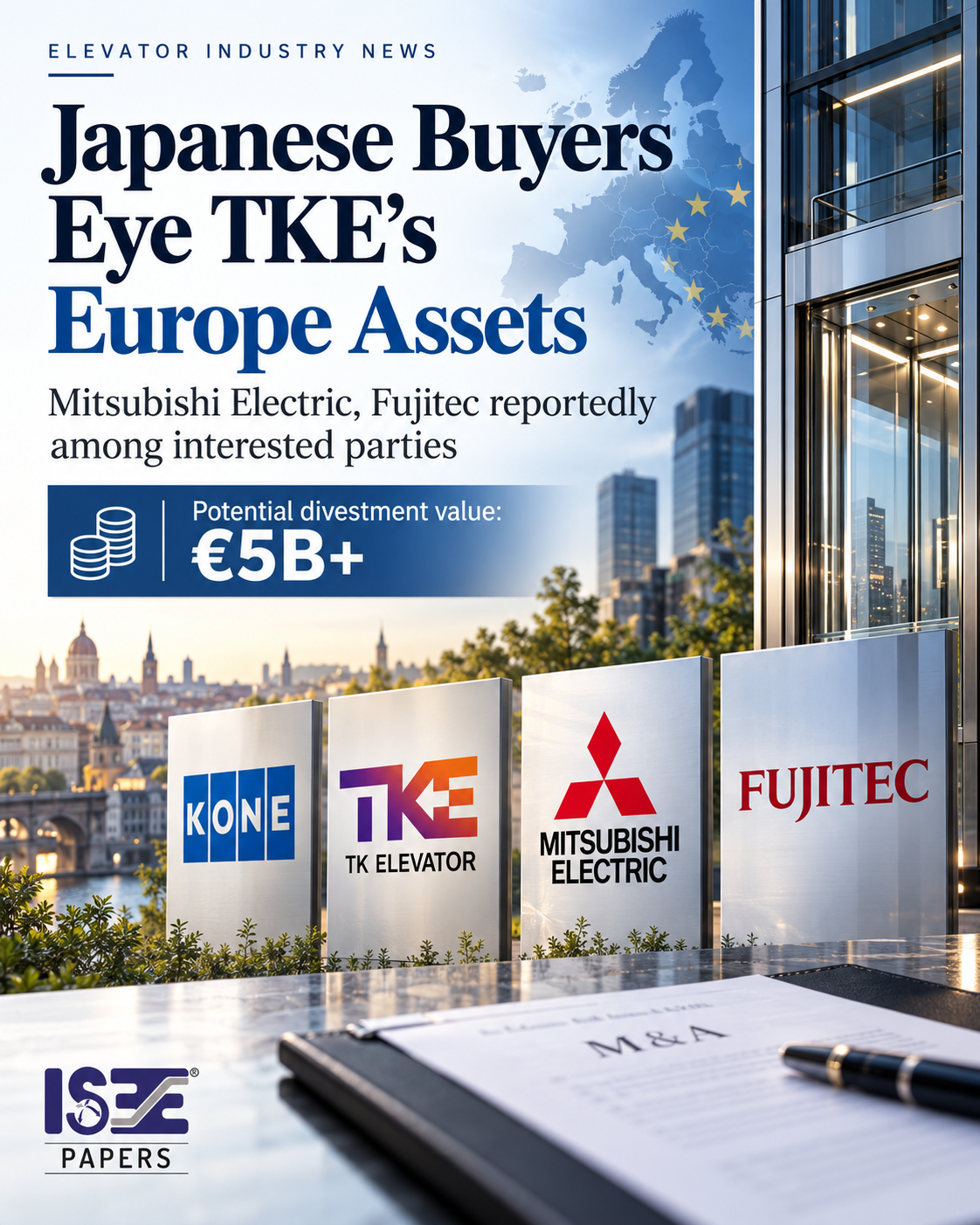
Kone and TK Elevator merger could reshape the global vertical transportation industry Kone and TK Elevator: The €25 Billion Merger Reshaping the Global Skyline DÜSSELDORF & HELSINKI – In a move that could fundamentally alter the landscape of the global vertical transportation industry, Finnish manufacturer Kone Oyj is reportedly in advanced negotiations to acquire its German rival, TK Elevator (TKE), for approximately €25 billion ($29.5 billion). The deal, which gained significant momentum in mid-April 2026, seeks to unite the world’s third and fourth largest elevator companies to create a global powerhouse capable of surpassing current industry leaders, Otis and Schindler. Advertisement Your Ad Here (728×90 / Responsive Banner) The Strategic Stakes The acquisition discussions involve Kone’s attempt to buy TKE from its private equity owners, Advent International and Cinven, who purchased the business from Thyssenkrupp for €17.2 billion in 2020. While TKE has been simultaneously preparing for an Initial Public Offering (IPO), market volatility in early 2026 has reportedly made a direct sale to Kone an increasingly attractive exit strategy for its owners. If finalized, the merger would consolidate: Market Dominance: The combined entity would control an estimated 40% of the global market. Financial Scale: TKE reported sales of €9.2 billion in the 2024/2025 fiscal year. Advertisement Your Ad Here (300×250 / Medium Rectangle) Competitor Backlash: The “Bloodbath” Warning The potential merger has already ignited fierce opposition from competitors. Schindler CEO Paolo Compagna has publicly vowed to challenge the deal before antitrust authorities in every available jurisdiction. The integration of two such massive, overlapping companies has been described as a potential “bloodbath” that could disrupt operations, customers, and teams globally. Advertisement Your Ad Here (728×90 / Responsive Banner) Industry Impact and Modernization Both companies have pivoted toward AI-driven solutions and predictive maintenance. A unified entity would hold the largest elevator performance dataset globally, accelerating the move toward smart, connected buildings. Advertisement Your Ad Here (300×250 / Medium Rectangle) What’s Next? As of late April 2026, no final decision has been announced. TK Elevator continues to maintain its IPO option while negotiations progress. Experts suggest that while the merger could improve technology integration, the transition for existing maintenance clients could take 12 to 18 months to stabilize. Advertisement Your Ad Here (Footer Banner) This article is published for informational and editorial purposes only. Views expressed may not reflect those of ISEE Papers. We do not guarantee accuracy or completeness. For full details, please read our complete disclaimer here: https://iseepapers.com/isee-papers-website-disclaimer/