







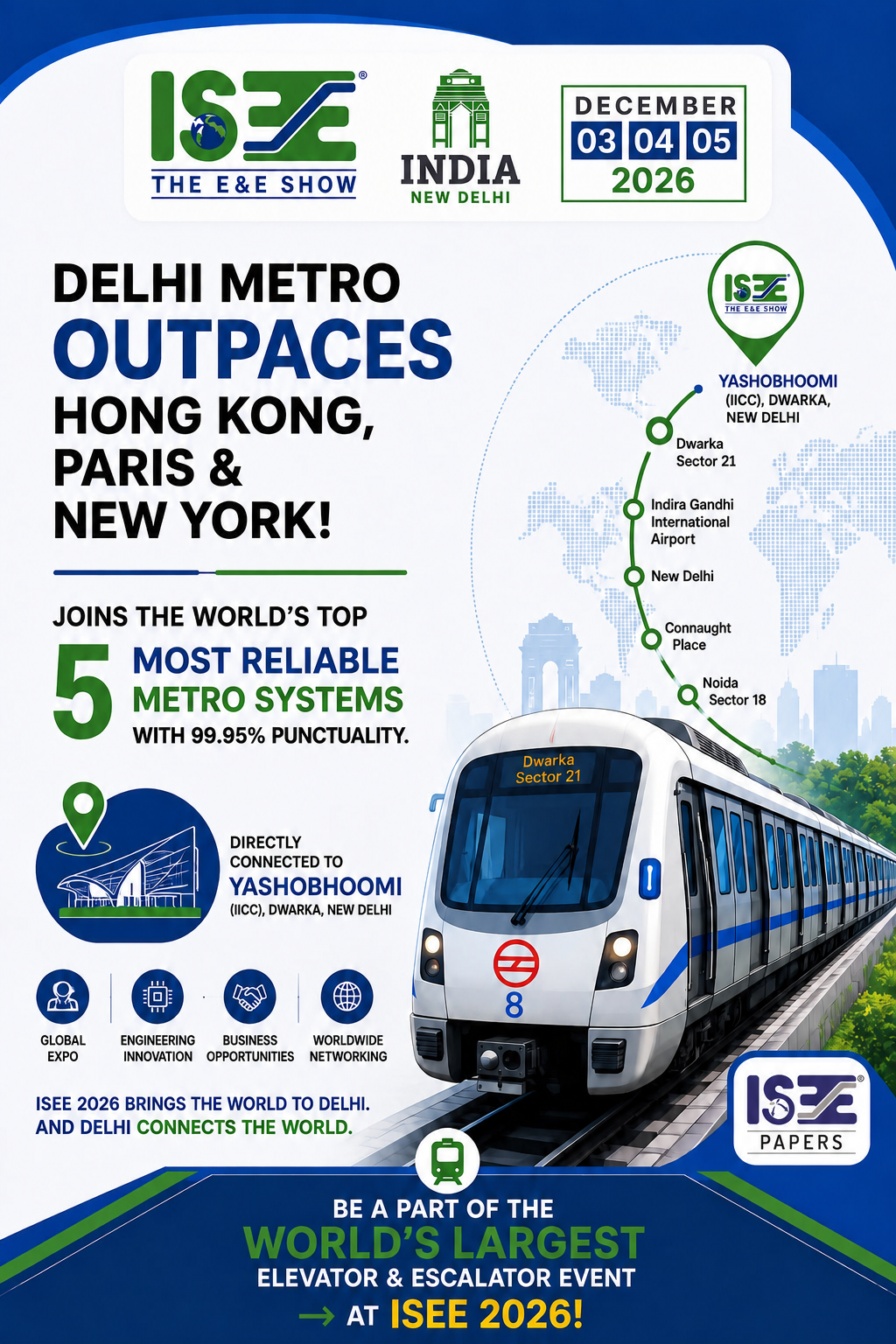
Delhi Metro has strengthened New Delhi’s position as a global mobility hub by recording an exceptional train punctuality rate of 99.95% in 2026.
The achievement comes as the city prepares to host ISEE, The E&E Show 2026, the international elevator and escalator industry event scheduled for 3, 4 and 5 December 2026 at Yashobhoomi (IICC), Dwarka, New Delhi.
According to the Delhi Metro Rail Corporation (DMRC), the network’s latest performance places it ahead of several established global transit systems, including those serving Hong Kong, Paris and New York.
Delhi Metro Joins the World’s Top Five
International benchmarking conducted by the Community of Metros, commonly known as COMET, has placed Delhi Metro among the world’s five most reliable metro systems.
COMET compares the operational performance of 45 leading metro networks worldwide. Its reliability assessment uses a two-minute delay criterion, allowing participating systems to evaluate their performance against a common international benchmark.
Delhi Metro’s position among the top five is particularly notable because of the network’s size, growing passenger demand and the complexity involved in maintaining frequent services across Delhi and the National Capital Region.
A Strict Standard for Punctuality
DMRC follows a stringent definition of train punctuality.
A train is considered delayed if it reaches its destination station more than 59 seconds behind schedule. Several international transport systems allow a longer time window before recording a service as delayed.
Maintaining 99.95% punctuality under such a demanding standard requires close coordination between trains, signalling systems, operations control centres, station personnel and maintenance teams.
The achievement is therefore not limited to trains arriving on time. It reflects the efficiency of the complete operational system supporting millions of passenger journeys every day.
Reliability Beyond the Timetable
Punctuality and reliability are related but distinct performance indicators.
Punctuality measures whether trains operate according to schedule. Reliability assesses how consistently trains and supporting systems function without failures that affect passenger services.
DMRC has reported a Mean Distance Between Failures, or MDBF, of 2.72 million car-kilometres. This metric represents the average distance travelled by Metro trains before encountering a service-affecting failure.
A high MDBF indicates dependable rolling stock, effective preventive maintenance and the ability to identify and address technical issues before they disrupt regular operations.
Maintaining Performance at Scale
Delhi Metro began passenger services in December 2002 with an 8.4-km corridor connecting Shahdara and Tis Hazari through six stations.
The network has since expanded to approximately 416.5 km, with 303 stations across 12 lines and 31 interchange stations connecting Delhi with the surrounding National Capital Region.
Average ridership has grown from around 82,000 passenger journeys during its first year to approximately 64.06 lakh journeys per day. The system also recorded more than 81 lakh passenger journeys on 8 August 2025, its highest single-day figure at the time.
Despite this rapid expansion, Delhi Metro has continued to improve its operational performance. Train punctuality increased from 98.27% in 2003 to 99.64% in 2005 and has remained above 99.9% in subsequent years.
Train frequency has also improved. On the busiest corridors, the minimum interval between services has reduced from approximately seven minutes during the Metro’s early years to around two minutes and 18 seconds.
ISEE 2026 Directly Connected to Delhi’s Mobility Network
Delhi Metro’s performance is especially relevant for the global elevator and escalator community travelling to ISEE, The E&E Show 2026.
The event venue, Yashobhoomi (IICC) in Dwarka, is directly connected to the Delhi Metro network through the Airport Express Line. Visitors can travel conveniently from New Delhi, Indira Gandhi International Airport and Dwarka Sector 21, with wider network access from locations such as Connaught Place and Noida Sector 18.
This connectivity will make it easier for exhibitors, business leaders, engineers and visitors arriving from India and overseas to reach the exhibition venue.
As highlighted in the event campaign:
“ISEE 2026 brings the world to Delhi. And Delhi connects the world.”
A Global Platform for the Elevator and Escalator Industry
ISEE 2026 will bring together elevator and escalator manufacturers, component suppliers, technology companies, engineers, architects, developers, consultants and industry decision-makers from across the world.
The exhibition will focus on four major opportunities:
- Global industry exposure
- Engineering and technological innovation
- New business opportunities
- Worldwide professional networking
The event will provide a platform for the industry to explore developments in elevator systems, escalator technology, accessibility, safety, automation, energy efficiency and the future of urban mobility.
Through its campaign, ISEE 2026 invites industry professionals to “be a part of the world’s largest elevator and escalator event at ISEE 2026.”
Delhi as a Global Mobility Destination
Delhi Metro’s inclusion among the world’s five most reliable metro systems demonstrates India’s ability to operate complex public infrastructure at an international level.
Its 99.95% punctuality rate reflects the operational discipline, engineering capability, maintenance systems and workforce coordination required to move millions of people safely and consistently.
As New Delhi welcomes the global elevator and escalator industry for ISEE 2026, the city’s Metro network will serve as more than a means of transportation. It will offer visitors a working example of how technology, engineering and large-scale mobility infrastructure can come together to keep a major city moving.
ISEE, The E&E Show 2026
3, 4 and 5 December 2026
Yashobhoomi (IICC), Dwarka, New Delhi
Sources: Delhi Metro LinkedIn post | Official DMRC statement | ETInfra report